
|
You entered: hydrogen
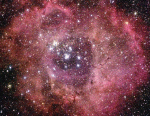 Star Cluster in the Rosette Nebula
22.05.1996
Embedded in the center of the colorful and photogenic Rosette Nebula is a bright, young open cluster. The bright blue stars in this cluster, labelled NGC 2244, emit ultraviolet light that knocks electrons away from hydrogen atoms.
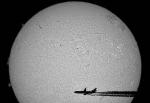 An Airplane in Front of the Sun
29.01.2001
Sometimes, good planes come to those who wait. Experienced solar photographer Thierry Lagault had noticed planes crossing in front of the Sun from his home in suburban Paris. He then got the idea for the above photograph, but had to wait through many near misses.
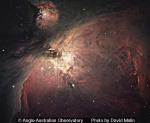 Water From Orion
21.04.1998
Is Orion all wet? Recent observations have confirmed that water molecules now exist in the famous Orion Nebula, and are still forming. The Orion Nebula (M42, shown above) is known to be composed mostly of hydrogen gas, with all other atoms and molecules being comparatively rare.
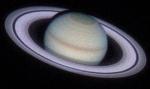 Saturn in Color
12.03.1997
Saturn is unusual but photogenic. The second largest planet in our Solar System, behind Jupiter, has been easily identifiable at night since history has been recorded. It was only with the invention of the telescope, however, that any evidence of its majestic ring system became apparent.
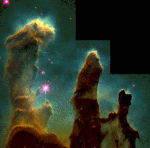 M16: Stars Upon Pillars
6.11.1995
How do stars form? This stunning picture taken recently by the Hubble Space Telescope gives us a first hand glimpse. Here evaporating gaseous globules (EGGs) are captured emerging from pillars of molecular hydrogen and dust in the Eagle Nebula (M16).
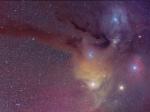 The Dark River to Antares
9.08.2004
Connecting the Pipe Nebula to the bright star Antares is a flowing dark cloud nicknamed the Dark River. The murkiness of the Dark River is caused by absorption of background starlight by dust, although the nebula contains mostly hydrogen and molecular gas.
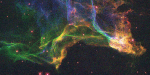 The Cygnus Loop
8.08.1998
15,000 years ago a star in the constellation of Cygnus exploded -- the shockwave from this supernova explosion is still expanding into interstellar space! The collision of this fast moving wall of gas with...
 The Cygnus Loop
3.08.1997
15,000 years ago a star in the constellation of Cygnus exploded -- the shockwave from this supernova explosion is still expanding into interstellar space! The collision of this fast moving wall of gas with...
 The Cat's Paw Nebula
7.12.1999
As soon as we find out whose cat did this . . . Nebulae are as famous for being identified with familiar shapes as perhaps cats are for getting into trouble. No cat, though, could have created the vast Cat's Paw Nebula visible in Scorpius.
 The Cygnus Loop
23.06.2001
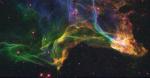
The shockwave from a 20,000 year-old supernova in the constellation of Cygnus supernova explosion is still expanding into interstellar space. The collision of this fast moving wall of gas with a stationary cloud...
|
January February March April May June July August September October |
|||||||||||||||||||||||||||||||||||||||||||||||||