
|
You entered: hydrogen
 Creature Aurora Over Norway
6.11.2013
It was Halloween and the sky looked like a creature. Exactly which creature, the astrophotographer was unsure (but possibly you can suggest one). Exactly what caused the eerie apparition was sure: one of the best auroral displays in recent memory. This spectacular aurora had an unusually high degree of detail.
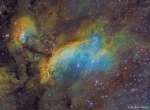 IC 4628: The Prawn Nebula
4.07.2016
South of Antares, in the tail of the nebula-rich constellation Scorpius, lies emission nebula IC 4628. Nearby hot, massive stars, millions of years young, radiate the nebula with invisible ultraviolet light, stripping electrons from atoms. The electrons eventually recombine with the atoms to produce the visible nebular glow, dominated by the red emission of hydrogen.
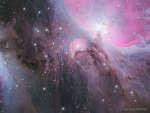 M43: Streams of Orion
6.10.2021
Where do the dark streams of dust in the Orion Nebula originate? This part of the Orion Molecular Cloud Complex, M43, is the often imaged but rarely mentioned neighbor of the more famous M42. M42, seen in part to the upper right, includes many bright stars from the Trapezium star cluster.
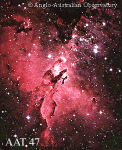 M16: Dust and an Open Cluster
1.11.1995
The photogenic M16 shown above is composed of a young star cluster and a spectacular emission nebulae lined with distinct regions of interstellar dust. Most of the stars in the cluster can be seen offset just above and to the right of the photograph's center.
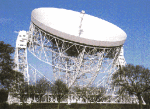 The 76 Meter Lovell Radio Telescope
8.03.1996
Jodrell Bank in England is the home of the Lovell Telescope one of the largest radio telescopes in the world. Completed in 1957 under the direction of Bernard Lovell, the 250 ft. diameter dish was the largest steerable radio telescope.
 Two Hours Before Neptune
22.09.2002
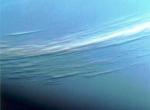
Two hours before closest approach to Neptune in 1989, the Voyager 2 robot spacecraft snapped this picture. Clearly visible for the first time were long light-colored cirrus-type clouds floating high in Neptune's atmosphere. Shadows of these clouds can even be seen on lower cloud decks.
 The Mysterious Cone Nebula
7.01.2002
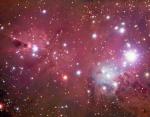
Sometimes the simplest shapes are the hardest to explain. For example, the origin of the mysterious cone-shaped region seen on the far left remains a mystery. The interstellar formation, dubbed the Cone Nebula, is located about 2700 light years away.
 Southern Saturn from Cassini
18.10.2004
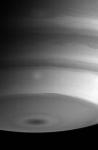
What happens to Saturn's pervasive clouds at its South Pole? Visible in the above image of Saturn are bright bands, dark belts and a dark spot right over the South Pole. The above...
 A Storm on Saturn
18.10.1995
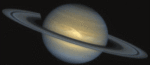
The white wisp shown on Saturn's cloud tops is actually a major storm system only discovered in December of 1994. Saturn's clouds are composed of primarily hydrogen and helium, but the storm's white clouds are actually ammonia ice crystals that have frozen upon upheaval to the top of the atmosphere.
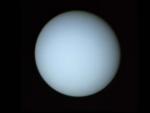 Uranus: The Tilted Planet
26.08.2001
Uranus is the third largest planet in our Solar System after Jupiter and Saturn. Uranus is composed mostly of rock and ices, but with a thick hydrogen and helium atmosphere. The blue hue of Uranus' atmosphere arises from the small amount of methane which preferentially absorbs red light.
|
January February March April May June July August September October |
|||||||||||||||||||||||||||||||||||||||||||||||||