
|
You entered: hydrogen
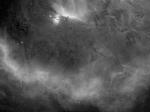 Barnards Loop around the Horsehead Nebula
17.04.2006
Why is the Horsehead Nebula surrounded by a bubble? Although glowing like an emission nebula, the origin of the bubble, known as Barnard's Loop, is currently unknown. Progenitor hypotheses include the winds from bright Orion stars and the supernovas of stars long gone.
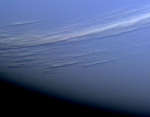 Two Hours Before Neptune
8.08.2010
Two hours before closest approach to Neptune in 1989, the Voyager 2 robot spacecraft snapped this picture. Clearly visible for the first time were long light-colored cirrus-type clouds floating high in Neptune's atmosphere. Shadows of these clouds can even be seen on lower cloud decks.
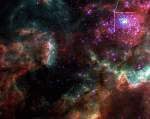 In the Center of 30 Doradus
4.10.1997
In the center of 30 Doradus lies a huge cluster of the largest, hottest, most massive stars known. The center of this cluster, known as R136, is boxed in the upper right portion of the above picture.
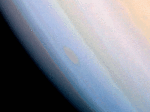 Saturn's Cloud Tops
17.03.1996
This close-up of the tops of Saturn's clouds was taken by the Voyager 1 robot spacecraft as it passed the giant planet in November 1980. Saturn's clouds are mostly composed of hydrogen and helium gas, but the small addition of other elements gives the clouds their colors.
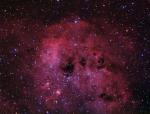 IC 410 and NGC 1893
15.08.2006
A faint, dusty rose of the northern sky, emission nebula IC 410 lies about 12,000 light-years away in the constellation Auriga. The cloud of glowing hydrogen gas is over 100 light-years across, sculpted by stellar winds and radiation from embedded open star cluster NGC 1893.
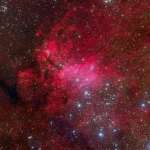 IC 4628: The Prawn Nebula
7.09.2012
South of Antares, in the tail of the nebula-rich constellation Scorpius, lies emission nebula IC 4628. Nearby hot, massive stars, millions of years young, radiate the nebula with invisible ultraviolet light, stripping electrons from atoms. The electrons eventually recombine with the atoms to produce the visible nebular glow, dominated by the red emission of hydrogen.
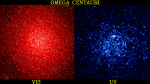 Globular Cluster Omega Centauri
4.10.1996
Does an old, red globular cluster have any hot, blue stars? The rightmost picture, taken by the Ultraviolet Imaging Telescope in ultraviolet light, shows that indeed it does. Pictured, Omega Centauri is the largest known globular cluster in our Galaxy, containing well over a million stars.
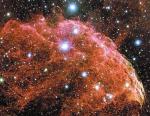 Galactic Supernova Remnant IC 443
3.09.2003
About 8000 years ago, a star in our Galaxy exploded. Ancient humans might have noticed the supernova as a temporary star, but modern humans can see the expanding shell of gas even today. Pictured...
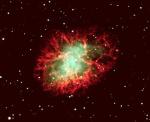 M1: Filaments of the Crab Nebula
8.02.1998
The Crab Nebula, filled with mysterious filaments, is the result of a star that exploded in 1054 AD. This spectacular supernova explosion was recorded by Chinese and (quite probably) Anasazi Indian astronomers. The filaments...
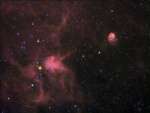 The Spider and the Fly
13.01.2010
Bright clusters and nebulae abound in the ancient northern constellation of Auriga. The region includes the open star cluster M38, emission nebula IC 410 with Tadpoles, Auriga's own Flaming Star Nebula IC 405, and this interesting pair IC 417 (lower left) and NGC 1931.
|
January February March April May June July August September October |
|||||||||||||||||||||||||||||||||||||||||||||||||