
|
You entered: hydrogen
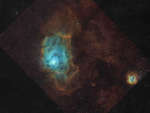 The Lagoon Nebula in Gas, Dust, and Stars
22.07.2009
Stars are battling gas and dust in the Lagoon Nebula but the photographers are winning. Also known as M8, this photogenic nebula is visible even without binoculars towards the constellation of Sagittarius. The energetic processes of star formation create not only the colors but the chaos.
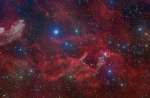 NGC 1788 and the Witch s Whiskers
19.04.2013
This skyscape finds an esthetic balance of interstellar dust and gas residing in the suburbs of the nebula rich constellation of Orion. Reflecting the light of bright star Rigel, Beta Orionis, the jutting, bluish chin of the Witch Head Nebula is at the upper left.
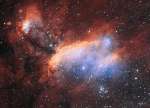 IC 4628: The Prawn Nebula
23.09.2013
South of Antares, in the tail of the nebula-rich constellation Scorpius, lies emission nebula IC 4628. Nearby hot, massive stars, millions of years young, radiate the nebula with invisible ultraviolet light, stripping electrons from atoms. The electrons eventually recombine with the atoms to produce the visible nebular glow, dominated by the red emission of hydrogen.
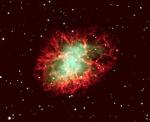 M1: Filaments of the Crab Nebula
7.02.1997
The Crab Nebula is filled with mysterious filaments. The Crab Nebula is the result of a star that exploded in 1054 AD. This spectacular supernova explosion was recorded by Chinese and (quite probably) Anasazi Indian astronomers.
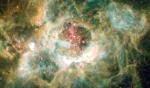 In the Center of NGC 604
5.03.1997
Stars are sometimes born in the midst of chaos. About 3 million years ago in the nearby galaxy M33, a large cloud of gas spawned dense internal knots which gravitationally collapsed to form stars. But NGC 604 was so large, it could form enough stars to make a globular cluster.
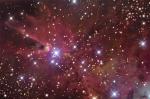 The Mysterious Cone Nebula
25.12.2005
Sometimes the simplest shapes are the hardest to explain. For example, the origin of the mysterious cone-shaped region seen on the far left remains a mystery. The interstellar formation, dubbed the Cone Nebula, is located about 2700 light years away.
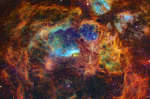 NGC 6357: The Lobster Nebula
28.10.2020
Why is the Lobster Nebula forming some of the most massive stars known? No one is yet sure. Cataloged as NGC 6357, the Lobster Nebula houses the open star cluster Pismis 24 near its center -- a home to unusually bright and massive stars.
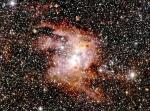 Giant Emission Nebula NGC 3603 in Infrared
14.08.2002
NGC 3603 is the largest region of glowing gas in our Milky Way galaxy. Spanning over 20 light years across, the giant emission nebula (HII region) is home to a massive star cluster, thick dust pillars, and a star about to explode.
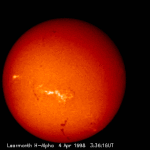 The Sun Changes
13.04.1998
Our Sun changes every day. This recent picture was taken in a very specific red color called Hydrogen-Alpha. Dark spots that might appear on the image are usually sunspots, dark magnetic depressions that are slightly cooler than the rest of the Sun's surface.
 The Heart and Soul Nebulas
11.02.2014
Is the heart and soul of our Galaxy located in Cassiopeia? Possibly not, but that is where two bright emission nebulas nicknamed Heart and Soul can be found. The Heart Nebula, officially dubbed IC 1805 and visible in the above zoomable view on the right, has a shape reminiscent of a classical heart symbol.
|
January February March April May June July August September October |
|||||||||||||||||||||||||||||||||||||||||||||||||