
|
You entered: hydrogen
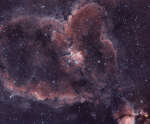 IC 1805: The Heart Nebula in HDR
25.10.2011
What powers the Heart Nebula? The large emission nebula dubbed IC 1805 looks, in whole, like a human heart. The nebula glows brightly in red light emitted by its most prominent element: hydrogen. The red glow and the larger shape are all created by a small group of stars near the nebula's center.
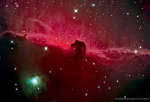 The Horsehead Nebula
31.12.2013
The Horsehead Nebula is one of the most famous nebulae on the sky. It is visible as the dark indentation to the red emission nebula in the center of the above photograph. The horse-head feature is dark because it is really an opaque dust cloud that lies in front of the bright red emission nebula.
 APOD: 2024 March 13 Б The Seagull Nebula
13.03.2024
A broad expanse of glowing gas and dust presents a bird-like visage to astronomers from planet Earth, suggesting its popular moniker: the Seagull Nebula. This portrait of the cosmic bird covers a 1.6-degree...
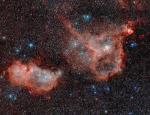 The Heart and Soul Nebulas
22.10.2003
Is heart and soul of our Galaxy located in Cassiopeia? Possibly not, but that is where two bright emission nebulas nicknamed Heart and Soul can be found. The Heart Nebula, officially dubbed IC 1805 and visible above on the right, has a shape reminiscent of a classical heart symbol.
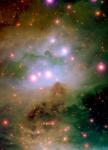 The Colorful Orion Nebula
14.09.1999
The Great Nebula in Orion is a colorful place. Visible to the unaided eye as a fuzzy patch in the constellation of Orion, this image taken with the Big Throughput Camera shows the Orion Nebula to be a busy neighborhood of young stars, hot gas, and dark dust.
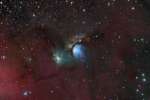 M78 Wide Field
26.11.2009
Interstellar dust clouds and glowing nebulae abound in the fertile constellation of Orion. One of the brightest, M78, is centered in this colorful, wide field view, covering an area north of Orion's belt. At a distance of about 1,500 light-years, the bluish reflection nebula is around 5 light-years across.
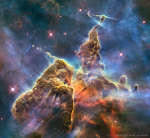 Mountains of Dust in the Carina Nebula
2.07.2017
It's stars versus dust in the Carina Nebula and the stars are winning. More precisely, the energetic light and winds from massive newly formed stars are evaporating and dispersing the dusty stellar nurseries in which they formed.
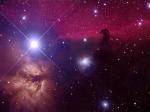 Orions Horsehead Nebula
29.01.2003
The Horsehead Nebula is one of the most famous nebulae on the sky. It is visible as the dark indentation to the red emission nebula seen above and to the right of center in the above photograph. The bright star on the left is located in the belt of the familiar constellation of Orion.
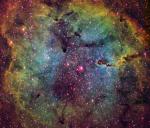 Emission Nebula IC 1396
5.08.2004
Sprawling across hundreds of light-years, emission nebula IC 1396 mixes glowing cosmic gas and dark dust clouds. Stars are forming in this area, only about 3,000 light-years from Earth. This particularly colorful view of the region is a composite of digital images recorded through narrow band filters.
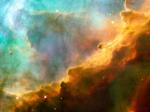 APOD: 2004 August 28- M17: A Hubble Close-Up
28.08.2004
Sculpted by stellar winds and radiation, these fantastic, undulating shapes lie within the stellar nursery known as M17, the Omega Nebula, some 5,500 light-years away in the nebula-rich constellation Sagittarius. The lumpy features...
|
January February March April May June July August September October |
|||||||||||||||||||||||||||||||||||||||||||||||||