
|
You entered: hydrogen
 The Gum Nebula
22.08.2009
Named for Australian astronomer Colin Stanley Gum (1924-1960), The Gum Nebula is so large and close it is actually hard to see. In fact, we are only about 450 light-years from the front edge and 1,500 light-years from the back edge of this cosmic cloud of glowing hydrogen gas.
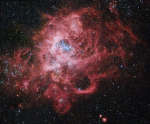 NGC 604: Giant Stellar Nursery
11.12.2012
Stars are sometimes born in the midst of chaos. About 3 million years ago in the nearby galaxy M33, a large cloud of gas spawned dense internal knots which gravitationally collapsed to form stars. NGC 604 was so large, however, it could form enough stars to make a globular cluster.
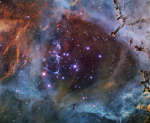 In the Heart of the Rosette Nebula
11.03.2014
In the heart of the Rosette Nebula lies a bright open cluster of stars that lights up the nebula. The stars of NGC 2244 formed from the surrounding gas only a few million years ago.
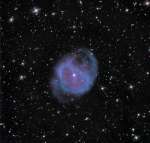 Planetary Nebula Abell 36
30.05.2014
The gorgeous, gaseous shroud of a dying sunlike star, planetary nebula Abell 36 lies a mere 800 light-years away in the constellation of Virgo. At that distance it spans over 1.5 light-years in this sharp telescopic view.
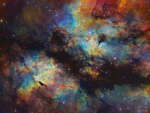 IC 1318: The Butterfly Nebula in Gas and Dust
16.03.2021
In the constellation of the swan near the nebula of the pelican lies the gas cloud of the butterfly next to a star known as the hen. That star, given the proper name Sadr...
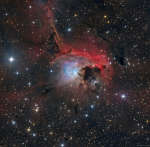 NGC 2626 along the Vela Molecular Ridge
4.02.2023
Centered in this colorful cosmic canvas, NGC 2626 is a beautiful, bright, blue reflection nebula in the southern Milky Way. Next to an obscuring dust cloud and surrounded by reddish hydrogen emission from large H II region RCW 27 it lies within a complex of dusty molecular clouds known as the Vela Molecular Ridge.
 A December Winter Night
28.12.2024
Orion seems to come up sideways, climbing over a distant mountain range in this deep skyscape. The wintry scene was captured from southern Poland on the northern hemisphere's long solstice night. Otherwise unseen nebulae hang in the sky, revealed by the camera modified to record red hydrogen-alpha light.
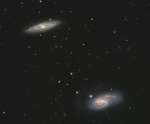 M65 and M66
15.06.2012
Nearby and bright, spiral galaxies M65 (top) and M66 stand out in this engaging cosmic snapshot. The pair are just 35 million light-years distant and around 100,000 light-years across, about the size of our own spiral Milky Way.
 APOD: 2024 November 18 Б Stars and Dust in the Pacman Nebula
18.11.2024
Stars can create huge and intricate dust sculptures from the dense and dark molecular clouds from which they are born. The tools the stars use to carve their detailed works are high energy light and fast stellar winds.
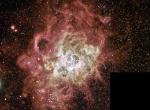 NGC 604: Giant Stellar Nursery
9.12.2003
Stars are sometimes born in the midst of chaos. About 3 million years ago in the nearby galaxy M33, a large cloud of gas spawned dense internal knots which gravitationally collapsed to form stars. NGC 604 was so large, however, it could form enough stars to make a globular cluster.
|
January February March April May June July August September October |
|||||||||||||||||||||||||||||||||||||||||||||||||