
|
You entered: hydrogen
 APOD: 2024 September 18 Б The Mermaid Nebula Supernova Remnant
18.09.2024
New stars are born from the remnants of dead stars. The gaseous remnant of the gravitational collapse and subsequent death of a very massive star in our Milky Way created the G296.5+10.0 supernova remnant, of which the featured Mermaid Nebula is part.
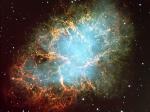 The Crab Nebula from VLT
22.11.1999
The Crab Nebula, filled with mysterious filaments, is the result of a star that was seen to explode in 1054 AD. This spectacular supernova explosion was recorded by Chinese and (quite probably) Anasazi Indian astronomers.
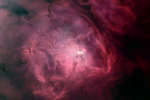 Gas and Dust of the Lagoon Nebula
15.07.2008
This beautiful cosmic cloud is a popular stop on telescopic tours of the constellation Sagittarius. Eighteenth century cosmic tourist Charles Messier cataloged the bright nebula as M8, while modern day astronomers recognize the Lagoon...
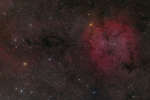 IC 1396 and Surrounding Starfield
19.08.2009
Sprawling across hundreds of light-years, emission nebula IC 1396, visible on the upper right, mixes glowing cosmic gas and dark dust clouds. Stars are forming in this area, only about 3,000 light-years from Earth. This wide angle view also captures surrounding emission and absorption nebula.
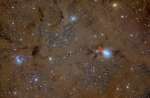 Stardust in Perseus
4.02.2010
This cosmic expanse of dust, gas, and stars covers close to 3 degrees on the sky in the heroic constellation Perseus. Right of center in the gorgeous skyscape is the dusty blue reflection nebula NGC 1333, about 1,000 light-years away. At that estimated distance, the field of view is about 50 light-years across.
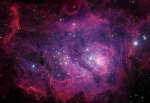 The Wide and Deep Lagoon
9.09.2016
Ridges of glowing interstellar gas and dark dust clouds inhabit the turbulent, cosmic depths of the Lagoon Nebula. Also known as M8, the bright star forming region is about 5,000 light-years distant.
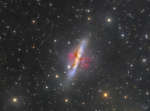 M82: Starburst Galaxy with a Superwind
9.07.2021
M82 is a starburst galaxy with a superwind. In fact, through ensuing supernova explosions and powerful winds from massive stars, the burst of star formation in M82 is driving a prodigious outflow. Evidence for the superwind from the galaxy's central regions is clear in sharp telescopic snapshot.
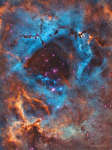 APOD: 2023 February 6 Б In the Heart of the Rosette Nebula
6.02.2023
In the heart of the Rosette Nebula lies a bright cluster of stars that lights up the nebula. The stars of NGC 2244 formed from the surrounding gas only a few million years ago.
 APOD: 2023 December 13 Б Deep Field: The Heart Nebula
13.12.2023
What excites the Heart Nebula? First, the large emission nebula on the left, catalogued as IC 1805, looks somewhat like a human heart. The nebula glows brightly in red light emitted by its most prominent element, hydrogen, but this long-exposure image was also blended with light emitted by silicon (yellow) and oxygen (blue).
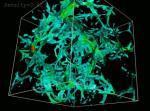 The Lyman Alpha Forest
24.02.1998
We live in a forest. Strewn throughout the universe are "trees" of hydrogen gas that absorb light from distant objects. These gas clouds leave numerous absorption lines in a distant quasar's spectra, together called the Lyman-alpha forest.
|
January February March April May June July August September October |
|||||||||||||||||||||||||||||||||||||||||||||||||