
|
You entered: hydrogen
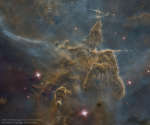 Mystic Mountain Dust Pillars
14.04.2015
It's stars versus dust in the Carina Nebula and the stars are winning. More precisely, the energetic light and winds from massive newly formed stars are evaporating and dispersing the dusty stellar nurseries in which they formed.
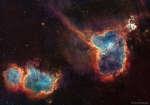 The Heart and Soul Nebulas
15.11.2016
Is the heart and soul of our Galaxy located in Cassiopeia? Possibly not, but that is where two bright emission nebulas nicknamed Heart and Soul can be found. The Heart Nebula, officially dubbed IC 1805 and visible in the featured image on the right, has a shape reminiscent of a classical heart symbol.
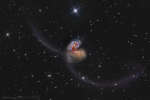 Exploring the Antennae
26.03.2021
Some 60 million light-years away in the southerly constellation Corvus, two large galaxies are colliding. Stars in the two galaxies, cataloged as NGC 4038 and NGC 4039, very rarely collide in the course of the ponderous cataclysm that lasts for hundreds of millions of years.
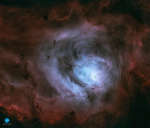 The Lagoon Nebula without Stars
7.08.2022
Ridges of glowing interstellar gas and dark dust clouds inhabit the turbulent, cosmic depths of the Lagoon Nebula. Also known as M8, the bright star forming region is about 5,000 light-years distant.
 APOD: 2023 July 26 Б IC 4628: The Prawn Nebula
25.07.2023
South of Antares, in the tail of the nebula-rich constellation Scorpius, lies emission nebula IC 4628. Nearby hot, massive stars, millions of years young, irradiate the nebula with invisible ultraviolet light, stripping electrons from atoms. The electrons eventually recombine with the atoms to produce the visible nebular glow, dominated by the red emission of hydrogen.
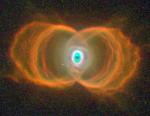 MyCn18: An Hourglass Nebula
15.06.2002
The sands of time are running out for the central star of this hourglass-shaped planetary nebula. With its nuclear fuel exhausted, this brief, spectacular, closing phase of a Sun-like star's life occurs as its outer layers are ejected - its core becoming a cooling, fading white dwarf.
 Jupiter from Voyager
25.06.1995
Imagine a hurricane that lasted for 300 years! This picture of the planet Jupiter was taken by the Voyager 1 spacecraft as it passed the planet in 1979. Jupiter, a gas giant planet with no solid surface, is the largest planet in the solar system and is made mostly of the hydrogen and helium.
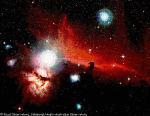 Orion's Horsehead Nebula
2.01.1999
The Horsehead Nebula is one of the most famous nebulae on the sky. It is visible as the black indentation to the red emission nebula seen just to the right of center of the above photograph. The bright star near the center is located in the belt of the familiar constellation of Orion.
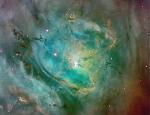 Stars and Dust of the Lagoon Nebula
8.09.2003
The large majestic Lagoon Nebula is home for many young stars and hot gas. Spanning 100 light years across while lying only about 5000 light years distant, the Lagoon Nebulae is so big and bright that it can be seen without a telescope toward the constellation of Sagittarius.
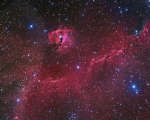 The Seagull Nebula
11.01.2014
A broad expanse of glowing gas and dust presents a bird-like visage to astronomers from planet Earth, suggesting its popular moniker - The Seagull Nebula. This portrait of the cosmic bird covers a 1.6 degree wide swath across the plane of the Milky Way, near the direction of Sirius, alpha star of the constellation Canis Major.
|
January February March April May June July August September October |
|||||||||||||||||||||||||||||||||||||||||||||||||