
|
You entered: hydrogen
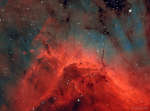 Pillars and Jets in the Pelican Nebula
3.03.2015
What dark structures arise from the Pelican Nebula? Visible as a bird-shaped nebula toward the constellation of a bird (Cygnus, the Swan), the Pelican Nebula is a place dotted with newly formed stars but fouled with dark dust.
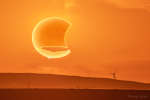 A Paper Moon Solar Eclipse
28.06.2021
It may look like a paper Moon. Sailing past a canvas Sun. But those are not cardboard clouds. And it's not make believe.б The featured picture of an orange colored sky is real -- a digital composite of two exposures of the solar eclipse that occurred earlier this month.
 APOD: 2024 February 5 Б In the Core of the Carina Nebula
5.02.2024
What's happening in the core of the Carina Nebula? Stars are forming, dying, and leaving an impressive tapestry of dark dusty filaments. The entire Carina Nebula, cataloged as NGC 3372, spans over 300 light years and lies about 8,500 light-years away in the constellation of Carina.
 APOD: 2024 February 21 Б Seagull Nebula over Pinnacles Peak
21.02.2024
The bird is bigger than the peak. Nicknamed for its avian shape, the Seagull Nebula is an emission nebula on the night sky that is vast, spanning an angle over five times the diameter of the full moon and over 200 light years.
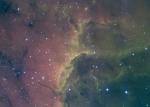 Pelican Nebula Ionization Front
3.07.2000
The Pelican Nebula is slowly being transformed. IC 5070, the official designation, is divided from the larger North America Nebula by a molecular cloud filled with dark dust. The Pelican, however, receives much study because it is a particularly active mix of star formation and evolving gas clouds.
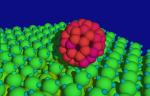 Fullerenes as Miniature Cosmic Time Capsules
19.01.2003
Scientists have found, unexpectedly, tiny time capsules from billions of years in the past. The discovery involves small molecules that can apparently become trapped during the formation of large enclosed molecules known as fullerenes, or buckyballs.
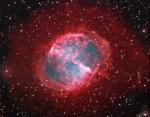 Dumbbell Nebula Halo
25.07.2003
In 1764, French astronomer Charles Messier sighted this gorgeous cosmic cloud which he described as an oval nebula without stars. Cataloged as M27, it is now popularly known as the Dumbbell Nebula...
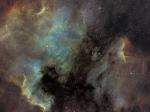 The North America and Pelican Nebulas
16.08.2006
Here are some familiar shapes in unfamiliar locations. This emission nebula on the left is famous partly because it resembles Earth's continent of North America. To the right of the North America Nebula, cataloged as NGC 7000, is a less luminous nebula that resembles a pelican dubbed the Pelican Nebula.
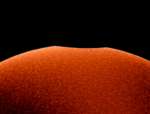 A Nibble on the Sun
14.07.2018
The smallest of the three partial solar eclipses during 2018 was just yesterday, Friday, July 13. It was mostly visible over the open ocean between Australia and Antarctica. Still, this video frame...
 APOD: 2023 August 7 Б The Pelican Nebula in Gas, Dust, and Stars
7.08.2023
The Pelican Nebula is slowly being transformed. IC 5070 (the official designation) is divided from the larger North America Nebula by a molecular cloud filled with dark dust. The Pelican, however, receives much study because it is a particularly active mix of star formation and evolving gas clouds.
|
January February March April May June July August September October |
|||||||||||||||||||||||||||||||||||||||||||||||||