
|
You entered: hydrogen
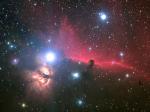 Orions Horsehead Nebula
21.03.2005
The Horsehead Nebula is one of the most famous nebulae on the sky. It is visible as the dark indentation to the red emission nebula seen above and to the right of center in the above photograph. The bright star on the left is located in the belt of the familiar constellation of Orion.
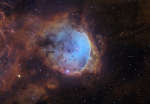 NGC 3324 in Carina
6.04.2018
This bright cosmic cloud was sculpted by stellar winds and radiation from the hot young stars of open cluster NGC 3324. With dust clouds in silhouette against its glowing atomic gas, the pocket-shaped star-forming region actually spans about 35 light-years. It lies some 7,500 light-years away toward the nebula rich southern constellation Carina.
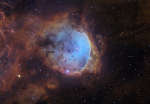 NGC 3324 in Carina
16.03.2019
This bright cosmic cloud was sculpted by stellar winds and radiation from the hot young stars of open cluster NGC 3324. With dust clouds in silhouette against its glowing atomic gas, the pocket-shaped star-forming region actually spans about 35 light-years. It lies some 7,500 light-years away toward the nebula rich southern constellation Carina.
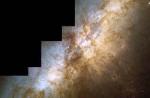 M82 After the Crash
12.03.2001
When did the Cigar Galaxy light up? Evidence indicates how M82, the Cigar Galaxy, became so bright and peculiar: it collided with neighboring galaxy M81. Astronomers become detectives, however, when trying to figure out when this collision occurred.
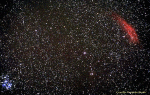 Seven Sisters Versus California
18.06.1996
In the lower left corner, dressed in blue, is the Pleiades. Also known as the Seven Sisters and M45, the Pleiades is one of the brightest and most easily visible open clusters on the sky. The Pleiades contains over 3000 stars, is about 400 light years away, and only 13 light years across.
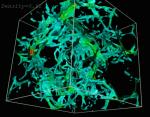 The Lyman Alpha Forest
26.01.2003
We live in a forest. Strewn throughout the universe are "trees" of hydrogen gas that absorb light from distant objects. These gas clouds leave numerous absorption lines in a distant quasar's spectra, together called the Lyman-alpha forest.
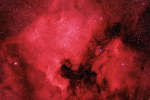 The North America and Pelican Nebulae
30.06.2009
Here are some familiar shapes in unfamiliar locations. This emission nebula on the left is famous partly because it resembles Earth's continent of North America. To the right of the North America Nebula, cataloged as NGC 7000, is a less luminous nebula that resembles a pelican dubbed the Pelican Nebula.
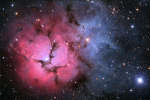 The Trifid Nebula in Stars and Dust
7.07.2009
Unspeakable beauty and unimaginable bedlam can be found together in the Trifid Nebula. Also known as M20, this photogenic nebula is visible with good binoculars towards the constellation of Sagittarius. The energetic processes of star formation create not only the colors but the chaos. The red-glowing gas results from high-energy starlight striking interstellar hydrogen gas.
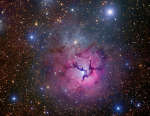 The Trifid Nebula is Stars and Dust
28.07.2010
Unspeakable beauty and unimaginable bedlam can be found together in the Trifid Nebula. Also known as M20, this photogenic nebula is visible with good binoculars towards the constellation of Sagittarius. The energetic processes of star formation create not only the colors but the chaos. The red-glowing gas results from high-energy starlight striking interstellar hydrogen gas.
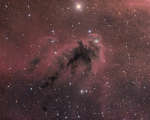 LDN 1622: Dark Nebula in Orion
2.02.2019
The silhouette of an intriguing dark nebula inhabits this cosmic scene. Lynds' Dark Nebula (LDN) 1622 appears against a faint background of glowing hydrogen gas only easily seen in long telescopic exposures of the region.
|
January February March April May June July August September October |
|||||||||||||||||||||||||||||||||||||||||||||||||