
|
You entered: hydrogen
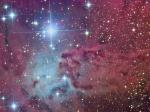 The Fox Fur Nebula
13.03.2005
The nebula surrounding bright star S Mon is filled with dark dust and glowing gas. The strange shapes originate from fine interstellar dust reacting in complex ways with the energetic light and hot gas being expelled by the young stars.
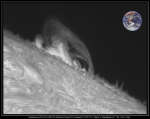 Sun and Prominence
4.03.2014
Dramatic prominences can sometimes be seen looming just beyond the edge of the sun. Such was the case last week as a large prominence, visible above, highlighted a highly active recent Sun. A waving...
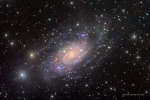 NGC 2403 in Camelopardalis
18.02.2016
Magnificent island universe NGC 2403 stands within the boundaries of the long-necked constellation Camelopardalis. Some 10 million light-years distant and about 50,000 light-years across, the spiral galaxy also seems to have more than its fair share of giant star forming HII regions, marked by the telltale reddish glow of atomic hydrogen gas.
 Stars, Gas, and Dust Battle in the Carina Nebula
14.08.2017
Chaos reigns in the Carina Nebula where massive stars form and die. Striking and detailed, this close-up of a portion of the famous nebula is a combination of light emitted by hydrogen (shown in red) and oxygen (shown in blue).
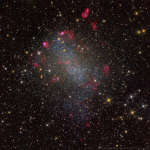 NGC 6822: Barnard s Galaxy
27.11.2020
Grand spiral galaxies often seem to get all the glory, flaunting their young, bright, blue star clusters in beautiful, symmetric spiral arms. But small galaxies form stars too, like nearby NGC 6822, also known as Barnard's Galaxy.
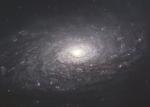 M63: The Sunflower Galaxy
27.06.2000
One of the bright spiral galaxies visible in the north sky is M63, the Sunflower Galaxy. M63, also catalogued as NGC 5055, can be found with a small telescope in the constellation of Canes Venaciti.
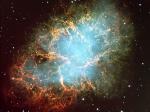 The Crab Nebula from VLT
24.03.2001
The Crab Nebula, filled with mysterious filaments, is the result of a star that was seen to explode in 1054 AD. This spectacular supernova explosion was recorded by Chinese and (quite probably) Anasazi Indian astronomers.
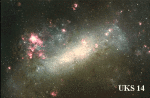 The Large Cloud of Magellan
18.09.1995
Magellan and his crew had plenty of time to study the southern sky during their famous voyage around the world. As a result, two fuzzy cloud like objects, nestled among the southern constellations of Doradus and Tucana are now known as the Clouds of Magellan.
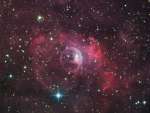 The Bubble Nebula
23.01.2009
Blown by the wind from a massive star, this interstellar apparition has a surprisingly familiar shape. Cataloged as NGC 7635, it is also known simply as The Bubble Nebula. This colorful telescopic image includes a long exposure through a hydrogen alpha filter to reveal details of the cosmic bubble and its environment.
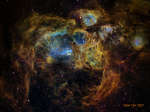 NGC 6357: The Lobster Nebula
25.12.2018
Why is the Lobster Nebula forming some of the most massive stars known? No one is yet sure. Cataloged as NGC 6357, the Lobster Nebula houses the open star cluster Pismis 24 near its center -- a home to unusually bright and massive stars.
|
January February March April May June July August September October |
|||||||||||||||||||||||||||||||||||||||||||||||||