
|
You entered: hydrogen
 APOD: 2025 August 29 Б A Dark Veil in Ophiuchus
29.08.2025
The diffuse hydrogen-alpha glow of emission region Sh2-27 fills this cosmic scene. The field of view spans nearly 3 degrees across the nebula-rich constellation Ophiuchus toward the central Milky Way. A Dark Veil...
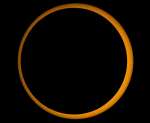 Millennium Annular Solar Eclipse
22.01.2010
The Moon's shadow raced across planet Earth on January 15. Observers within the central shadow track were able to witness an annular solar eclipse as the Moon's apparent size was too small to completely cover the Sun.
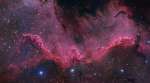 Along the Cygnus Wall
11.03.2015
The W-shaped ridge of emission featured in this vivid skyscape is known as the Cygnus Wall. Part of a larger emission nebula with a distinctive outline popularly called The North America Nebula, the cosmic ridge spans about 20 light-years.
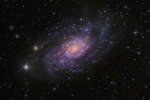 NGC 2403 in Camelopardalis
26.03.2015
Magnificent island universe NGC 2403 stands within the boundaries of the long-necked constellation Camelopardalis. Some 10 million light-years distant and about 50,000 light-years across, the spiral galaxy also seems to have more than its fair share of giant star forming HII regions, marked by the telltale reddish glow of atomic hydrogen gas.
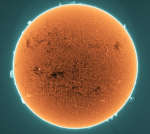 Prominences and Filaments on the Active Sun
15.06.2024
This colorized and sharpened image of the Sun is composed of frames recording emission from hydrogen atoms in the solar chromosphere on May 15. Approaching the maximum of solar cycle 25, a multitude of active regions and twisting, snake-like solar filaments are seen to sprawl across the surface of the active Sun.
 NGC 7293: The Helix Nebula
24.10.2024
A mere seven hundred light years from Earth toward the constellation Aquarius, a star is dying. The once sun-like star's last few thousand years have produced the Helix Nebula. Also known...
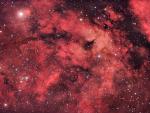 A Cygnus Star Field
28.07.2004
In the constellation of the swan near the nebula of the pelican lies the gas cloud of the butterfly surrounding a star known as the hen. That star, given the proper name Sadr, is visible to the unaided eye but found here as the brightest object on the upper left.
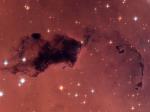 A Dust Cloud in NGC 281
20.04.2006
Stars themselves can create huge and intricate dust sculptures from the dense and dark molecular clouds from which they are born. The tools the stars use to carve their detailed works are high energy light and fast stellar winds.
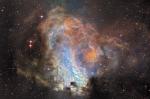 Star Factory Messier 17
10.08.2007
Sculpted by stellar winds and radiation, the star factory known as Messier 17 lies some 5,500 light-years away in the nebula-rich constellation Sagittarius. At that distance, this 30 arcminute field of view spans almost 50 light-years.
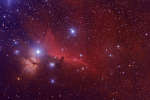 Orion s Horsehead Nebula
21.02.2008
The Horsehead Nebula is one of the most famous nebulae on the sky. It is visible as the dark indentation to the red emission nebula seen just below and left of center in the this photograph. The brightest star on the left is located in the belt of the familiar constellation Orion.
|
January February March April May June July August September October |
|||||||||||||||||||||||||||||||||||||||||||||||||