
|
You entered: hydrogen
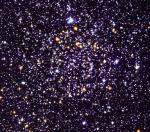 NGC 7789: Galactic Star Cluster
9.07.1999
At 1.6 billion years old, this cluster of stars is beginning to show its age. NGC 7789 is an open or galactic star cluster about 8,000 light-years distant toward the constellation Cassiopeia and lies near the plane of our Milky Way galaxy.
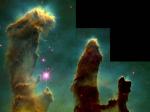 M16: Pillars of Creation
18.02.2007
It has become one of the most famous images of modern times. This image, taken with the Hubble Space Telescope in 1995, shows evaporating gaseous globules (EGGs) emerging from pillars of molecular hydrogen gas and dust.
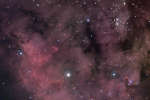 The Star Pillars of Sharpless 171
18.10.2009
Towering pillars of cold gas and dark dust adorn the center star forming region of Sharpless 171. An open cluster of stars is forming there from the gas in cold molecular clouds. As energetic...
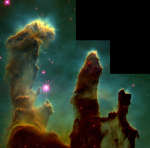 M16: Pillars of Creation
28.03.2010
It has become one of the most famous images of modern times. This image, taken with the Hubble Space Telescope in 1995, shows evaporating gaseous globules (EGGs) emerging from pillars of molecular hydrogen gas and dust.
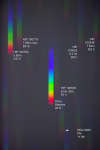 A Spectrum of Nova Delphini
23.08.2013
When a new star appeared in the constellation Delphinus late last week, astronomers found its spectrum hinted at the apparition's true nature. Now known as Nova Delphini, its visible light spectrum near maximum...
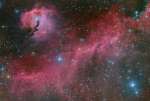 The Seagull Nebula
29.08.2015
A broad expanse of glowing gas and dust presents a bird-like visage to astronomers from planet Earth, suggesting its popular moniker - The Seagull Nebula. This portrait of the cosmic bird covers a 1.6 degree wide swath across the plane of the Milky Way, near the direction of Sirius, alpha star of the constellation Canis Major.
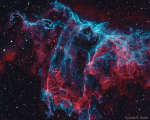 NGC 6995: The Bat Nebula
25.11.2019
Do you see the bat? It haunts this cosmic close-up of the eastern Veil Nebula. The Veil Nebula itself is a large supernova remnant, the expanding debris cloud from the death explosion of a massive star.
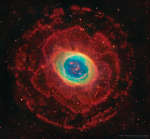 Rings Around the Ring Nebula
18.08.2021
The Ring Nebula (M57), is more complicated than it appears through a small telescope. The easily visible central ring is about one light-year across, but this remarkably deep exposure - a collaborative effort combining data from three different large telescopes - explores the looping filaments of glowing gas extending much farther from the nebula's central star.
 APOD: 2026 September 29 Б Sh2 188: The Shrimp Nebula
29.09.2026
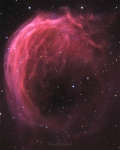
What causes the swirl in the Shrimp Nebula? Its high speed is likely. What is sure is that Sh2-188 is one of the larger planetary nebulas on the night sky, by angular size, spanning about half the diameter of the Moon.
 Galactic Supernova Remnant IC 443
21.07.1999
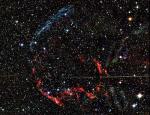
About 8000 years ago, a star in our Galaxy exploded. Ancient humans might have noticed the supernova as a temporary star, but modern humans can see the expanding shell of gas even today.
|
January February March April May June July August September October |
|||||||||||||||||||||||||||||||||||||||||||||||||