
|
You entered: hydrogen
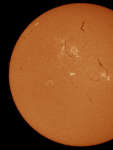 A Transit of Mercury
12.05.2016
On May 9, the diminutive disk of Mercury spent about seven and a half hours crossing in front of the Sun as viewed from the general vicinity of Earth. It was the second of 14 transits of the Solar System's innermost planet in the 21st century.
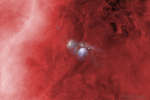 APOD: 2026 January 28 Б M78: Reflecting Blue in a Sea of Red
28.01.2026
In the vast Orion Molecular Cloud complex, several bright blue nebulas are particularly apparent. Pictured here in the center are two of the most prominent reflection nebulas - dust clouds lit by the reflecting light of bright embedded stars. The more famous nebula is M78, in the image center, cataloged over 200 years ago.
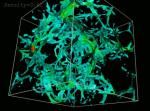 The Lyman Alpha Forest
12.11.2000
We live in a forest. Strewn throughout the universe are "trees" of hydrogen gas that absorb light from distant objects. These gas clouds leave numerous absorption lines in a distant quasar's spectra, together called the Lyman-alpha forest.
 In the Vicinity of the Cone Nebula
23.11.2008
Strange shapes and textures can be found in neighborhood of the Cone Nebula. The unusual shapes originate from fine interstellar dust reacting in complex ways with the energetic light and hot gas being expelled by the young stars.
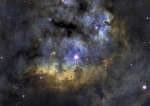 NGC 7822 in Cepheus
16.11.2011
Hot, young stars and cosmic pillars of gas and dust seem to crowd into NGC 7822. At the edge of a giant molecular cloud toward the northern constellation Cepheus, the glowing star forming region lies about 3,000 light-years away. Within the nebula, bright edges and dark shapes are highlighted in this colorful skyscape.
 The Seagull Nebula
8.03.2012
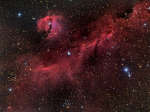
A broad expanse of glowing gas and dust presents a bird-like visage to astronomers from planet Earth, suggesting its popular moniker - The Seagull Nebula. This portrait of the cosmic bird covers a 1.6 degree wide swath across the plane of the Milky Way, near the direction of Sirius, alpha star of the constellation Canis Major.
 Melotte 15 in the Heart
9.11.2012
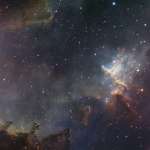
Cosmic clouds seem to form fantastic shapes in the central regions of emission nebula IC 1805. Of course, the clouds are sculpted by stellar winds and radiation from massive hot stars in the nebula's newborn star cluster, Melotte 15.
 MyCn18: An Hourglass Planetary Nebula
10.05.2015
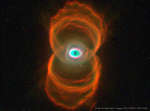
The sands of time are running out for the central star of this hourglass-shaped planetary nebula. With its nuclear fuel exhausted, this brief, spectacular, closing phase of a Sun-like star's life occurs as its outer layers are ejected - its core becoming a cooling, fading white dwarf.
 South of Carina
22.05.2020
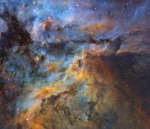
With natal dust clouds in silhouette against glowing atomic gas, this colorful and chaotic vista lies within one of the largest star forming regions in the Milky Way galaxy, the Great Carina Nebula.
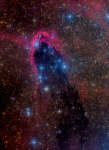 The Dark Tower in Scorpius
15.07.2021
In silhouette against a crowded star field along the tail of the arachnalogical constellation Scorpius, this dusty cosmic cloud evokes for some the image of an ominous dark tower. In fact, clumps of dust...
|
January February March April May June July August September October |
|||||||||||||||||||||||||||||||||||||||||||||||||