
|
You entered: cluster
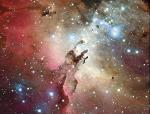 The Eagle Nebula from CFHT
13.02.2003
Bright blue stars are still forming in the dark pillars of the Eagle Nebula. Made famous by a picture from the Hubble Space Telescope in 1995, the Eagle Nebula shows the dramatic process of star formation. To the upper right of the nebula in the above picture lies the heart of the open cluster M16.
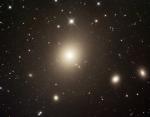 Elliptical Galaxy M87
20.05.2006
In spiral galaxies, majestic winding arms of young stars and interstellar gas and dust rotate in a flat disk around a bulging galactic nucleus. But elliptical galaxies seem to be simpler. Lacking gas and dust to form new stars, their randomly swarming older stars, give them an ellipsoidal (egg-like) shape.
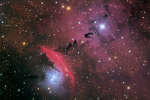 Stars, Dust and Nebula in NGC 6559
2.08.2009
When stars form, pandemonium reigns. A textbook case is the star forming region NGC 6559. Visible above are red glowing emission nebulas of hydrogen, blue reflection nebulas of dust, dark absorption nebulas of dust, and the stars that formed from them.
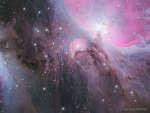 M43: Streams of Orion
6.10.2021
Where do the dark streams of dust in the Orion Nebula originate? This part of the Orion Molecular Cloud Complex, M43, is the often imaged but rarely mentioned neighbor of the more famous M42. M42, seen in part to the upper right, includes many bright stars from the Trapezium star cluster.
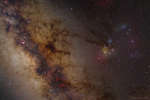 A Wide Field Image of the Galactic Center
6.01.2012
From Sagittarius to Scorpius, the central Milky Way is a truly beautiful part of planet Earth's night sky. The gorgeous region is captured in this wide field image spanning about 30 degrees.
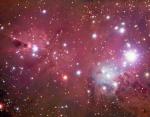 The Mysterious Cone Nebula
7.01.2002
Sometimes the simplest shapes are the hardest to explain. For example, the origin of the mysterious cone-shaped region seen on the far left remains a mystery. The interstellar formation, dubbed the Cone Nebula, is located about 2700 light years away.
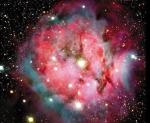 IC 5146: The Cocoon Nebula
14.10.2002
How did this nebula get created? The Cocoon Nebula, cataloged as IC 5146, is a strikingly beautiful nebula located about 4,000 light years away toward the constellation of Cygnus. Inside the Cocoon is a newly developing open cluster of stars.
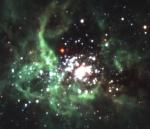 Tarantula
4.06.1997
NGC 2070 is an immense star forming region in a nearby galaxy known as the Large Magellanic Cloud. Its spidery appearance is responsible for its popular name, "The Tarantula Nebula", except that this tarantula is about 1,000 light-years across, and 165,000 light-years away in the southern constellation Dorado.
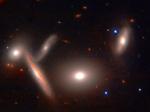 Hickson Compact Group 40
17.02.1999
Galaxies, like stars, frequently form groups. A group of galaxies is a system containing more than two galaxies but less than the tens or hundreds typically found in a cluster of galaxies. A most...
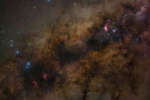 Sagittarius and the Central Milky Way
19.05.2009
What does the center of our Milky Way Galaxy look like? In visible light, no one knows! It is not possible to see the Galactic center in light our eyes are sensitive to because the thick dust in the plane of our Galaxy obscures it.
|
January February March April May June July August September October |
|||||||||||||||||||||||||||||||||||||||||||||||||