
|
You entered: cluster
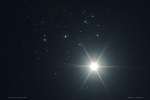 Venus and the Sisters
6.04.2012
After wandering about as far from the Sun on the sky as Venus can get, the brilliant evening star crossed paths with the Pleiades star cluster earlier this week. The beautiful conjunction was enjoyed by skygazers around the world. Taken on April 2, this celestial group photo captures the view from Portal, Arizona, USA.
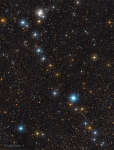 APOD: 2023 January 3 Б Kembles Cascade of Stars
2.01.2023
This line of stars is real. A little too faint to see with the unaided eye, KembleБs Cascade of stars inspires awe when seen with binoculars. Like the Big Dipper though, KembleБs Cascade is an asterism, not a constellation. The asterism is visible in the northern sky toward the long-necked constellation of the Giraffe (Camelopardalis).
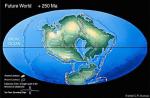 Pangea Ultima: Earth in 250 Million Years
2.10.2000
Is this what will become of the Earth's surface? The surface of the Earth is broken up into several large plates that are slowly shifting. About 250 million years ago, the plates...
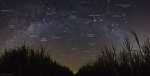 A Starry Night in Brazil
9.05.2009
This panoramic image tracing constellations in the southern sky shows off a beautiful vista toward the center of our Milky Way Galaxy. It was recorded just last month near the city of Campos in northeastern Rio de Janeiro state, Brazil.
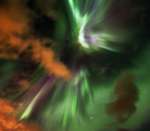 Cloudy Night of the Northern Lights
30.09.2011
On September 26, a large solar coronal mass ejection smacked into planet Earth's magnetosphere producing a severe geomagnetic storm and wide spread auroras. Captured here near local midnight from Kvaløya island outside Tromsø in northern Norway, the intense auroral glow was framed by parting rain clouds.
 APOD: 2024 December 2 Б NGC 300: A Galaxy of Stars
1.12.2024
This galaxy is unusual for how many stars it seems that you can see. Stars are so abundantly evident in this deep exposure of the spiral galaxy NGC 300 because so many of these stars are bright blue and grouped into resolvable bright star clusters.
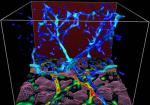 A Universe in a Box
21.08.1997
Is this our universe? Possibly. It is one computerized guess of how gas in the universe was distributed billions of years ago, at redshift 3, when the universe was only a quarter of its present age.
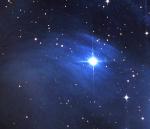 Reflection Nebula NGC 1435
28.02.1999
Reflection nebulae reflect light from a nearby star. Many small carbon grains in the nebula reflect the light. The blue color typical of reflection nebula is caused by blue light being more efficiently scattered by the carbon dust than red light.
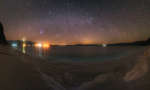 Sky Panorama Over Lake Salda
22.04.2009
As midnight approached, a spectacular sky appeared. Such was the case last month from the shore of Lake Salda in southwestern Turkey. In the above night sky panorama, rocky sand covers the foreground, while building lights are visible across the lake.
 Panorama of the Whale Galaxy
17.05.2010
The see the full length of this blue whale, scroll right. NGC 4631 is a big beautiful spiral galaxy seen edge-on at only about 30 million light-years away. This galaxy's slightly distorted wedge shape led to its popular moniker of the Whale galaxy.
|
January February March April May June July August September October |
|||||||||||||||||||||||||||||||||||||||||||||||||