
|
You entered: spacecraft
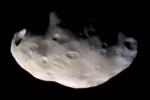 Pandora: A Shepherd Moon of Saturn
23.11.2005
What does Saturn's small moon Pandora look like? To help find out, the robot Cassini spacecraft now orbiting Saturn passed about 50,000 kilometers from the unusual moon in early September. The highest resolution image of Pandora ever taken was then captured and is shown above in representative colors.
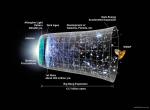 Inflating the Universe
23.03.2006
The Universe is expanding gradually now. But its initial expansion was almost impossibly rapid as it likely grew from quantum scale fluctuations in a trillionth of a second. In fact, this cosmological scenario, known as Inflation, is now reported to be further quantified by an analysis of three years of data from the WMAP spacecraft.
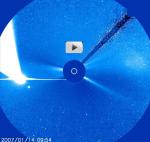 SOHO: Comet McNaught Movie
20.01.2007
This frame from a spectacular time lapse movie shows Comet McNaught - the Great Comet of 2007 - sweeping through the inner solar system. The movie frames were recorded from January 12 through Jan 16 by a coronograph onboard the sun-staring SOHO spacecraft.
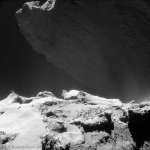 A Cliff Looming on Comet 67P
20.05.2015
What that looming behind this gravel-strewn hill on Comet ChuryumovGerasimenko? A jagged cliff. The unusual double-lobed nucleus of Comet 67P/ChuryumovGerasimenko lends itself to unusual and dramatic vistas, another of which has been captured by the Rosetta spacecraft that arrived at the comet last September.
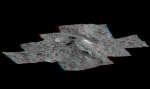 3D Ahuna Mons
19.03.2016
Get out your red/blue glasses and gaze across Ceres at mysterious mountain Ahuna Mons. Shown in a 3D anaglyph perspective view, the mosaicked image data was captured in December of 2015, taken from the Dawn spacecraft's low-altitude mapping orbit about 385 kilometers above the surface of the dwarf planet.
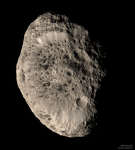 Saturns Hyperion in Natural Color
14.05.2018
What lies at the bottom of Hyperion's strange craters? To help find out, the robot Cassini spacecraft now orbiting Saturn swooped past the sponge-textured moon in 2005 and 2010 and took images of unprecedented detail.
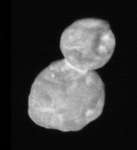 Ultima and Thule
3.01.2019
On January 1 New Horizons encountered the Kuiper Belt object nicknamed Ultima Thule. Some 6.5 billion kilometers from the Sun, Ultima Thule is the most distant world ever explored by a spacecraft from Earth.
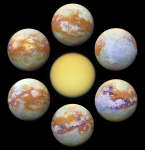 Seeing Titan
20.08.2020
Shrouded in a thick atmosphere, Saturn's largest moon Titan really is hard to see. Small particles suspended in the upper atmosphere cause an almost impenetrable haze, strongly scattering light at visible wavelengths and hiding Titan's surface features from prying eyes.
 Spiral Eddies On Planet Earth
20.10.1997
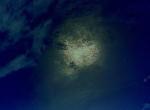
Can you identify this stellar nebula? How many light-years from Earth did you say? Looking like a twisting cloud of gas and dust between the stars this wispy nebulosity is actually close by - a spiral eddy formed near the North Atlantic Gulf Stream off the East coast of the US.
 Persistent Saturnian Auroras
22.02.2005
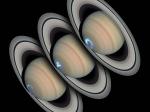
Are Saturn's auroras like Earth's? To help answer this question, the Hubble Space Telescope and the Cassini spacecraft monitored Saturn's South Pole simultaneously as Cassini closed in on the gas giant in January 2004. Hubble snapped images in ultraviolet light, while Cassini recorded radio emissions and monitored the solar wind.
|
January February March April May June July August September October |
|||||||||||||||||||||||||||||||||||||||||||||||||