
|
You entered: spacecraft
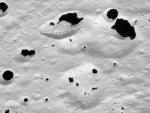 Iapetus in Black and White
14.09.2007
Iapetus, Saturn's third largest moon, is a candidate for the strangest moon of Saturn. Tidally locked in its orbit around the ringed gas giant, Iapetus is sometimes called the yin-yang moon because...
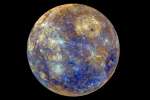 Colors of Mercury
1.03.2013
The colors of the solar system's innermost planet are enhanced in this tantalizing view, based on global image data from the Mercury-orbiting MESSENGER spacecraft. Human eyes would not discern the clear color differences but they are real none the less, indicating distinct chemical, mineralogical, and physical regions across the cratered surface.
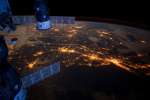 Yuri s Planet
12.04.2013
On another April 12th, in 1961, Soviet cosmonaut Yuri Alexseyevich Gagarin became the first human to see planet Earth from space. Commenting on his view from orbit he reported, "The sky is very dark; the Earth is bluish. Everything is seen very clearly".
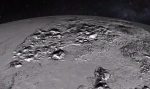 Fly Over Pluto
18.07.2015
It took 9.5 years to get this close, but you can now take a virtual flight over Pluto in this animation of image data from the New Horizons spacecraft. The Plutonian terrain unfolding 48,000 miles (77,000 kilometers) below is identified as Norgay Montes, followed by Sputnik Planum.
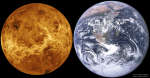 Venus Unveiled
10.02.2019
What does Venus look like beneath its thick clouds? These clouds keep the planet's surface hidden from even the powerful telescopic eyes of Earth-bound astronomers. In the early 1990s, though, using imaging radar...
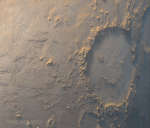 APOD: 2026 February 1 Б Galle: Happy Face Crater on Mars
1.02.2026
Mars has put on a happy face. The Martian crater Galle is famous because it has internal markings that make it look like a face that is both smiling and winking. These markings were originally discovered in the 1970s in pictures taken by the Viking Orbiter.
 A Polar Martian Dust Storm
9.10.2000
On August 29, a large dust storm was photographed erupting out from the north polar cap of Mars. Such dust storms are not uncommon as summer advances in the north. In the above picture...
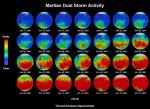 Martian Dust Storm
27.07.2001
If you've been unhappy with the weather on Earth, check out Mars, now in the grip of a planet-wide dust storm. Above, observations from the orbiting Mars Global Surveyor (MGS) spacecraft illustrate the storm's progress through July 21.
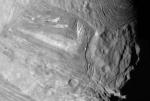 Miranda, Chevron, and Alonso
16.02.2002
Miranda is a bizarre world which surely had a tempestuous past. The innermost of the larger Uranian moons, Miranda is almost 300 miles in diameter and was discovered on today's date in 1948 by American planetary astronomer Gerard Kuiper.
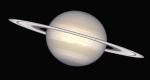 Natural Saturn On The Cassini Cruise
11.05.2002
What could you see approaching Saturn aboard an interplanetary cruise ship? Your view would likely resemble this subtly shaded image of the gorgeous ringed gas giant. Processed by the Hubble Heritage project, the picture...
|
January February March April May June July August September October |
|||||||||||||||||||||||||||||||||||||||||||||||||