
|
You entered: spacecraft
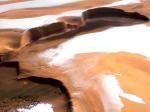 Steep Cliffs on Mars
14.03.2005
Vertical cliffs of nearly two kilometers occur near the North Pole of Mars. Also visible in the above image of the Martian North Polar Cap are red areas of rock and sand, white areas of ice, and dark areas of unknown composition but hypothesized to be volcanic ash.
 Earthrise
23.12.2005
In December of 1968, the Apollo 8 crew flew from the Earth to the Moon and back again. Frank Borman, James Lovell, and William Anders were launched atop a Saturn V rocket on December 21, circled the Moon ten times in their command module, and returned to Earth on December 27.
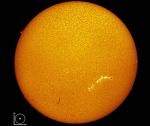 Simulated Transit of Mercury
7.11.2006
Mercury, the solar system's innermost planet, will spend about five hours crossing in front of the Sun today - beginning at 1912 UT (2:12pm EST), November 8. Specially equipped telescopes are highly recommended...
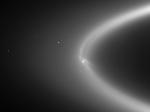 Enceladus Creates Saturns E Ring
27.03.2007
The active moon Enceladus appears to be making Saturn's E ring. An amazing picture showing the moon at work was taken late last year by the Saturn-orbiting Cassini spacecraft and is shown above. Enceladus is the bright point near the center, right near the center of Saturn's E ring.
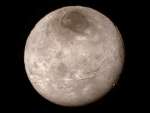 Charon
16.07.2015
Icy world Charon is 1,200 kilometers across. That makes Pluto's largest moon only about 1/10th the size of planet Earth but a whopping 1/2 the diameter of Pluto itself. Charon is seen in unprecedented detail in this image from New Horizons.
 Martian Chiaroscuro
28.08.2020
Deep shadows create dramatic contrasts between light and dark in this high-resolution close-up of the martian surface. Recorded on January 24, 2014 by the HiRISE camera on board the Mars Reconnaissance Orbiter, the scene spans about 1.5 kilometers.
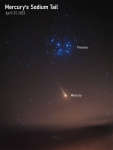 Mercurys Sodium Tail
2.05.2022
That's no comet. Below the Pleiades star cluster is actually a planet: Mercury. Long exposures of our Solar System's innermost planet may reveal something unexpected: a tail. Mercury's thin atmosphere contains small amounts of sodium that glow when excited by light from the Sun.
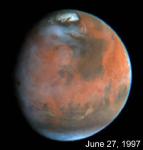 Mars: A Journey's End
3.07.1997
Mars Pathfinder is nearing the end of its 7 month journey. The robot spacecraft is scheduled to use parachutes, rockets, and airbags to "bouncedown" on the red planet tomorrow - July 4th. This Hubble Space Telescope image of Mars was taken a few days ago to check on the weather.
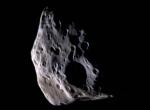 Small Moon Epimetheus
29.04.2005
Small saturnian moon Epimetheus (ep-ee-MEE-thee-us) is at most 116 kilometers across. Its cratered surface and irregular shape are highlighted by dramatic shadows in this composite close-up image from the Cassini spacecraft. However, orbiting 91,000 kilometers above Saturn's cloud tops, Epimetheus is not alone.
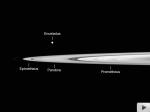 Movie: Cassini Crosses Saturns Ring Plane
30.01.2007
What would the rings of Saturn look like if you passed right through the ring plane? To find out, NASA aimed cameras from the Cassini spacecraft right at Saturn's rings as the robotic explorer passed from the sunlit side of the rings to the shadowed side.
|
January February March April May June July August September October |
|||||||||||||||||||||||||||||||||||||||||||||||||