
|
You entered: spacecraft
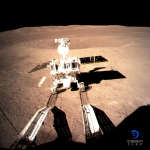 Yutu 2 on the Farside
4.01.2019
On January 3, the Chinese Chang'e-4 spacecraft made the first successful landing on the Moon's farside. Taken by a camera on board the lander, this image is from the landing site inside Von Karman crater.
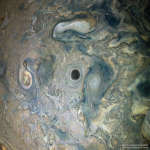 Jupiter Abyss
9.06.2019
What's that black spot on Jupiter? No one is sure. During the latest pass of NASA's Juno around Jupiter, the robotic spacecraft imaged an usually dark cloud feature informally dubbed the Abyss. Surrounding cloud patterns show the Abyss to be at the center of a vortex.
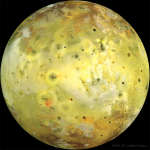 Io in True Color
10.12.2022
The strangest moon in the Solar System is bright yellow. The featured picture, an attempt to show how Io would appear in the "true colors" perceptible to the average human eye, was taken in 1999 July by the Galileo spacecraft that orbited Jupiter from 1995 to 2003.
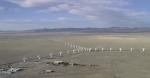 A Very Large Array of Radio Telescopes
20.06.1999
Pictured above is one of the world's premiere radio astronomical observatories: The Very Large Array (VLA). Each antenna dish is as big as a house (25 meters across) and mounted on railroad tracks. The VLA consists of 27 dishes - together capable of spanning the size of a city (35 kilometers).
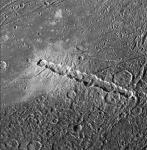 Ganymede: Torn Comet Crater Chain
14.12.2001
This striking line of 13 closely spaced craters on Jupiter's moon Ganymede was photographed by the Galileo spacecraft in 1997. The picture covers an area about 120 miles wide and the chain of craters cuts across a sharp boundary between dark and light terrain. What caused this crater chain?
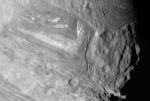 Miranda, Chevron, and Alonso
5.03.1999
Miranda is a bizarre world which surely had a tempestuous past. The innermost of the larger Uranian moons, Miranda is almost 300 miles in diameter and was discovered in 1948 by American planetary astronomer Gerard Kuiper.
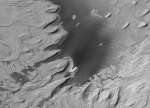 Ancient Layered Hills on Mars
28.11.2009
Is this a picture of Mars or Earth? Oddly enough, it is a picture of Mars. What may appear to some as a terrestrial coastline is in fact a formation of ancient layered hills and wind-blown sand on Mars. The above-pictured region spans about three kilometers in Schiaparelli Crater.
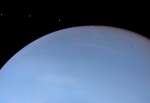 Despina, Moon of Neptune
16.01.2014
Despina is a tiny moon of Neptune. A mere 148 kilometers across, diminutive Despina was discovered in 1989, in images from the Voyager 2 spacecraft taken during its encounter with the solar system's most distant gas giant planet.
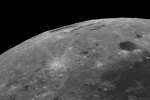 Western Moon, Eastern Sea
27.01.2022
The Mare Orientale, Latin for Eastern Sea, is one of the most striking large scale lunar features. The youngest of the large lunar impact basins it's very difficult to see from an earthbound perspective.
 Odyssey Over Mars
21.03.2002
Scroll right and journey for 300 kilometers over Terra Sirenum in the cratered highlands of southern Mars. The infrared view, 32 kilometers wide, was recently recorded by the THEMIS camera on board the orbiting Mars Odyssey spacecraft.
|
January February March April May June July August September October |
|||||||||||||||||||||||||||||||||||||||||||||||||