
|
You entered: spacecraft
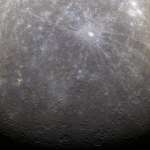 MESSENGER at Mercury
31.03.2011
On March 17, the MESSENGER spacecraft became the first to orbit Mercury, the solar system's innermost planet. This is its first processed color image since entering Mercury orbit. Larger, denser, and with almost twice the surface gravity of Earth's moon, Mercury still looks moon-like at first glance.
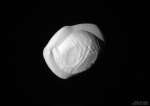 Saturns Moon Pan from Cassini
13.03.2017
Why does Saturn's moon Pan look so odd? Images taken last week from the robotic Cassini spacecraft orbiting Saturn have resolved the moon in unprecedented detail. The surprising images reveal a moon that looks something like a walnut with a slab through its middle.
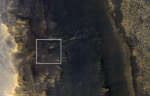 Opportunity After the Storm
4.10.2018
On Mars dust storms can't actually blow spacecraft over, but they can blot out the Sun. Over three months ago a planet-wide dust storm caused a severe lack of sunlight for the Mars rover Opportunity at its location near the west rim of Endeavor crater.
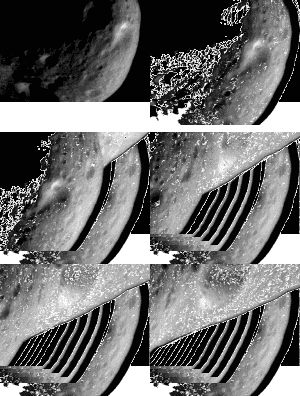 Flying Over Asteroid Eros West End
17.04.2000
The robot spacecraft NEAR Shoemaker continues to orbit asteroid Eros. This condensed 40-minute long time-lapse sequence taken last month shows what it looks like to pass within 200 kilometers of Eros' west end. The north pole of the rotating mountain is toward the bottom of the picture.
 In Chandor Chasma on Mars
31.05.2002
Scroll right and dive into a spectacular canyon on Mars. This daytime infrared view, recently recorded by the THEMIS camera on board the orbiting Mars Odyssey spacecraft, covers a 30 by 175 kilometer swath running along the canyon floor.
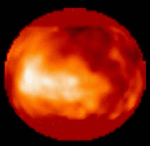 A Glimpse of Titan's Surface
21.10.1995
The surface of Titan, Saturn's largest moon, is normally hidden from view by its thick, hazy atmosphere. However, for the first time astronomers have been able to see surface features in images like the one above, made at near-infrared wavelengths with the Hubble Space Telescope.
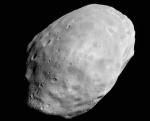 Martian Moon Phobos from MGS
1.07.2003
Why is Phobos so dark? Phobos, the largest and innermost of two Martian moons, is the darkest moon in the entire Solar System. Its unusual orbit and color indicate that it may be a captured asteroid composed of a mixture of ice and dark rock.
 The Moving Moons of Saturn
27.06.2006
The moons of Saturn never stop. A space traveler orbiting the ringed giant planet would witness a continuing silent dance where Saturn's multiple moons pass near each other in numerous combinations. Like a miniature Solar System, the innermost moons orbit Saturn the fastest.
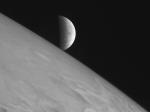 Europa Rising
7.05.2007
When passing Jupiter on your way to Pluto, what should you look for? NASA pondered just this question recently, and the response from one space enthusiast was to capture the above breathtaking moonrise.
 Saturns Moon Helene in Color
2.05.2012
Although its colors may be subtle, Saturn's moon Helene is an enigma in any light. The moon was imaged in unprecedented detail last June as the robotic Cassini spacecraft orbiting Saturn swooped to within a single Earth diameter of the diminutive moon.
|
January February March April May June July August September October |
|||||||||||||||||||||||||||||||||||||||||||||||||