
|
You entered: constellation
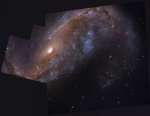 NGC 2442: Galaxy in Volans
25.03.2010
Distorted galaxy NGC 2442 can be found in the southern constellation of the flying fish, (Piscis) Volans. Located about 50 million light-years away, the galaxy's two spiral arms extending from a pronounced central bar have a hook-like appearance in wide-field images.
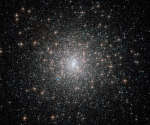 Globular Cluster M15 from Hubble
3.05.2011
Stars, like bees, swarm around the center of bright globular cluster M15. This ball of over 100,000 stars is a relic from the early years of our Galaxy, and continues to orbit the Milky Way's center.
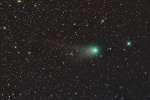 Tails of Comet Garradd
20.10.2011
A good target for binoculars and small telescopes, Comet Garradd (C/2009 P1) now shines in planet Earth's evening skies, a steady performer but just below naked-eye visibility. Telescopic images like this composite from...
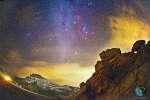 Deep Orion Over the Canary Islands
23.01.2012
Which attracts your eye more -- the sky or the ground? On the ground are rocky peaks in Teide National Park on Tenerife Island of the Spanish Canary Islands off the northwestern coast of Africa. The volcanic landscape features old island summits and is sometimes used as a testbed for instruments on future Martian rovers.
 The Medusa Nebula
25.10.2012
Braided, serpentine filaments of glowing gas suggest this nebula's popular name, The Medusa Nebula. Also known as Abell 21, this Medusa is an old planetary nebula some 1,500 light-years away in the constellation Gemini. Like its mythological namesake, the nebula is associated with a dramatic transformation.
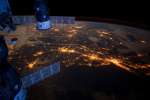 Yuri s Planet
12.04.2013
On another April 12th, in 1961, Soviet cosmonaut Yuri Alexseyevich Gagarin became the first human to see planet Earth from space. Commenting on his view from orbit he reported, "The sky is very dark; the Earth is bluish. Everything is seen very clearly".
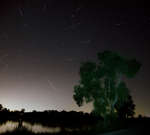 Perseid Meteors Over Ontario
13.08.2013
Where are all of these meteors coming from? In terms of direction on the sky, the pointed answer is the constellation of Perseus. That is why the meteor shower that peaked over the past few days is known as the Perseids -- the meteors all appear to come from a radiant toward Perseus.
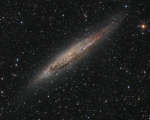 Nearby Spiral Galaxy NGC 4945
28.05.2015
Large spiral galaxy NGC 4945 is seen edge-on near the center of this cosmic galaxy portrait. In fact, NGC 4945 is almost the size of our own Milky Way Galaxy. Its own dusty disk, young blue star clusters, and pink star forming regions standout in the sharp, colorful telescopic image.
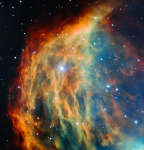 The Medusa Nebula
12.06.2015
Braided, serpentine filaments of glowing gas suggest this nebula's popular name, The Medusa Nebula. Also known as Abell 21, this Medusa is an old planetary nebula some 1,500 light-years away along the southern border of the constellation Gemini. Like its mythological namesake, the nebula is associated with a dramatic transformation.
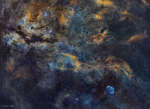 Central Cygnus Skyscape
19.08.2015
In cosmic brush strokes of glowing hydrogen gas, this beautiful skyscape unfolds across the plane of our Milky Way Galaxy and the center of the northern constellation Cygnus the Swan. The featured image spans about six degrees.
|
January February March April May June July August September October |
|||||||||||||||||||||||||||||||||||||||||||||||||