
|
You entered: constellation
 Young Star Cluster NGC 1333
12.09.2024
This spectacular mosaic of images from the James Webb Space Telescope peers into the heart of young star cluster NGC 1333. A mere 1,000 light-years distant toward the heroic constellation Perseus, the nearby star cluster lies at the edge of the large Perseus molecular cloud.
 Curly Spiral Galaxy M63
22.05.2025
A bright spiral galaxy of the northern sky, Messier 63 is nearby, about 30 million light-years distant toward the loyal constellation Canes Venatici. Also cataloged as NGC 5055, the majestic island universe is nearly 100,000 light-years across, about the size of our own Milky Way.
 Jupiter and the Meteors from Gemini
18.12.2025
Jupiter, the Solar System's ruling gas giant, is the brightest celestial beacon at the center of this composite night skyscape. The scene was constructed by selecting the 40 exposures containing meteors from about...
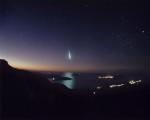 Mediterranean Leonid 2001
7.12.2001
A road trip from Ankara to the Mediterranean coast southeast of Antalya, Turkey found clear skies and splendid scenery for astrophotographer Tunc Tezel's viewing of the 2001 Leonid meteor storm. There he captured this dream-like image of a fireball meteor near the twilit horizon, reflected in calm ocean waters.
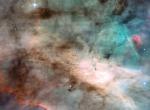 In the Center of the Omega Nebula
8.02.2004
In the depths of the dark clouds of dust and molecular gas known as the Omega Nebula, stars continue to form. The above image from the Hubble Space Telescope's Advanced Camera for Surveys shows exquisite detail in the famous star-forming region.
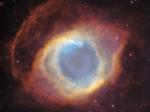 The Helix Nebula from Blanco and Hubble
29.12.2004
How did a star create the Helix nebula? The shapes of planetary nebula like the Helix are important because they likely hold clues to how stars like the Sun end their lives. Recent observations...
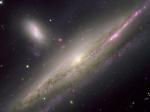 NGC 1531/2: Interacting Galaxies
1.03.2005
This dramatic image of an interacting pair of galaxies was made using 8-meter Gemini South telescope at Cerro Pachon, Chile. NGC 1531 is the background galaxy with a bright core just above center and NGC 1532 is the foreground spiral galaxy laced with dust lanes.
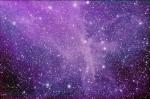 An Unexplored Nebula
29.09.2005
The combined light of the stars of the Milky Way are reflected by this cosmic dust cloud that soars some 300 light-years above the plane of our Galaxy. Dubbed the Angel Nebula by astronomer...
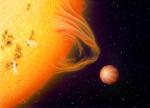 Upsilon Andromedae: An Extra Solar System
16.04.1999
Yesterday, astronomers announced the discovery of the first system of planets around a normal star other than our Sun. Previously, only single planet star systems had been found. Subtle changes in the wobble of Upsilon Andromedae, a Sun-like star in the constellation of Andromeda, allowed astronomers led by R. Paul Butler (AAO) and Geoffrey W.
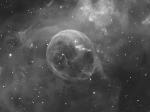 NGC 7635: The Bubble
18.10.2006
What created this huge space bubble? Blown by the wind from a star, this tantalizing, ghostly apparition is cataloged as NGC 7635, but known simply as The Bubble Nebula. Astronomer Eric Mouquet's striking view utilizes a long exposure with hydrogen alpha light to reveal the intricate details of this cosmic bubble and its environment.
|
January February March April May June July August September October |
|||||||||||||||||||||||||||||||||||||||||||||||||