
|
You entered: constellation
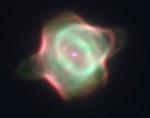 Hen 1357: New Born Nebula
6.10.2001
This Hubble Space Telescope snapshot shows Hen-1357, the youngest known planetary nebula. Graceful, gentle curves and symmetry suggest its popular name - The Stingray Nebula. Observations in the 1970s detected no nebular material, but this image from March 1996 clearly shows the Stingray's emerging bubbles and rings of shocked and ionized gas.
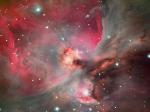 The Great Nebula in Orion
13.02.2002
Few astronomical sights excite the imagination like the nearby stellar nursery known as the Orion Nebula. The Nebula's glowing gas surrounds hot young stars at the edge of an immense interstellar molecular cloud only 1500 light-years away.
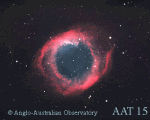 NGC 7293: The Helix Nebula
17.04.1996
The Helix nebula (New General Catalog number 7293) is estimated to be a mere 450 light-years from the Sun, in the direction of the constellation Aquarius. At that distance it may well be the closest planetary nebula, offering a dramatic snapshot of a brief final evolutionary stage in the life of a solar-type star.
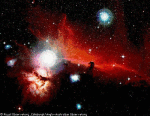 Orion's Horsehead Nebula
2.10.1996
The Horsehead Nebula is arguably the most famous nebula on the sky. It is visible as the black indentation to the red emission nebula seen just to the right of center of the above photograph. The bright star near the center is located in the belt of the familiar constellation of Orion.
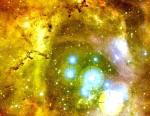 In the Center of the Rosette Nebula
29.04.2003
In the heart of the Rosette Nebula lies a bright open cluster of stars that lights up the nebula. The stars of NGC 2244 formed from the surrounding gas only a few million years ago. This just-released image taken by the CFHT's new MegaPrime camera shows the region in unprecedented detail.
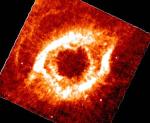 Infrared Helix
1.09.1997
Five hundred light years from Earth, in the constellation Aquarius, a sun-like star is dying. Its last few thousand years have produced the Helix, a well studied and nearby example of a Planetary Nebula - typical of this final phase of stellar evolution.
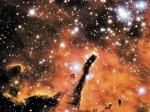 NGC 6823: Cloud Sculpting Star Cluster
4.10.2004
Star cluster NGC 6823 is ready for its close-up. The center of the open cluster, visible on the upper right, formed only about two million years ago and is dominated in brightness by a host of bright young blue stars.
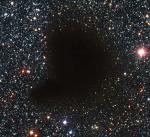 Molecular Cloud Barnard 68
11.05.1999
Where did all the stars go? What used to be considered a hole in the sky is now known to astronomers as a dark molecular cloud. Here, a high concentration of dust and molecular gas absorb practically all the visible light emitted from background stars.
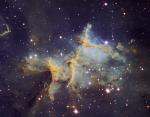 Central IC 1805
22.09.2006
Cosmic clouds seem to form fantastic shapes in the central regions of emission nebula IC 1805. Of course, the clouds are sculpted by stellar winds and radiation from massive hot stars in the nebula's newborn star cluster (aka Melotte 15).
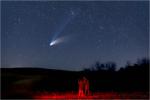 Hale Bopp: The Great Comet of 1997
31.03.2007
Ten short years ago, Comet Hale-Bopp rounded the Sun and offered a dazzling spectacle in planet Earth's night. This stunning view, recorded shortly after the comet's perihelion passage on April 1, 1997, features the memorable tails of Hale-Bopp -- a whitish dust tail and blue ion tail.
|
January February March April May June July August September October |
|||||||||||||||||||||||||||||||||||||||||||||||||