
|
You entered: constellation
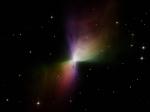 The Boomerang Nebula in Polarized Light
14.09.2005
Why did the Boomerang Nebula form? The symmetric cloud dubbed the Boomerang appears to have been created by a high-speed wind of gas and dust blowing from an aging central star at speeds of nearly 600,000 kilometers per hour.
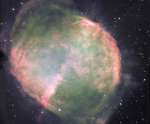 M27: Not A Comet
26.06.2008
Born on June 26th in 1730, astronomer Charles Messier scanned 18th century French skies for comets. To avoid confusion and aid his comet hunting, he diligently recorded this object as number 27 on his list of things which are definitely not comets.
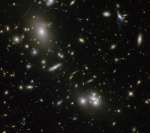 Looking Through Abell 68
8.03.2013
Want to use a cluster of galaxies as a telescope? It's easier than you might think as distant galaxy clusters naturally act as strong gravitional lenses. In accordance with Einstein's theory...
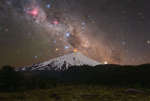 Southern Cross over Chilean Volcano
25.01.2021
Have you ever seen the Southern Cross? This famous four-star icon is best seen from Earth's Southern Hemisphere. The featured image was taken last month in Chile and captures the Southern Cross just to the left of erupting Villarrica, one of the most active volcanos in our Solar System.
 Small Star
20.11.1999
A dim double star system cataloged as Gliese 623 lies 25 light-years from Earth, in the constellation of Hercules. The individual stars of this binary system were distinguished for the first time when the Hubble Space Telescope's Faint Object Camera recorded this image in June 1994.
 W5: Pillars of Star Creation
16.09.2008
How do stars form? A study of star forming region W5 by the orbiting Spitzer Space Telescope provides clear clues by recording that massive stars near the center of empty cavities are older than stars near the edges.
 MACSJ0025: Two Giant Galaxy Clusters
Collide
MACSJ0025: Two Giant Galaxy Clusters
Collide
17.09.2008
What happens when two of the largest objects in the universe collide? No one was quite sure, but the answer is giving clues to the nature of mysterious dark matter. In the case of MACSJ0025.
 Orion in Gas, Dust, and Stars
12.02.2012
The constellation of Orion holds much more than three stars in a row. A deep exposure shows everything from dark nebula to star clusters, all embedded in an extended patch of gaseous wisps in the greater Orion Molecular Cloud Complex.
 R Leporis: A Vampire's Star
31.10.2018
Better known as Hind's Crimson Star, R Leporis is a rare star in planet Earth's night sky. It's also a shocking shade of red. The star's discoverer, 19th century English...
 Three Clusters in Puppis
18.02.2022
Galactic or open star clusters are young. The swarms of stars are born together near the plane of the Milky Way, but their numbers steadily dwindle as cluster members are ejected by galactic tides and gravitational interactions.
|
January February March April May June July August September October |
|||||||||||||||||||||||||||||||||||||||||||||||||