
|
You entered: constellation
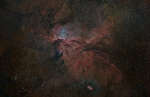 NGC 6188 and NGC 6164
1.02.2014
Fantastic shapes lurk in clouds of glowing gas in NGC 6188, about 4,000 light-years away. The emission nebula is found near the edge of a large molecular cloud unseen at visible wavelengths, in the southern constellation Ara.
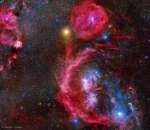 A 212 Hour Exposure of Orion
22.11.2015
The constellation of Orion is much more than three stars in a row. It is a direction in space that is rich with impressive nebulas. To better appreciate this well-known swath of sky, an extremely long exposure was taken over many clear nights in 2013 and 2014.
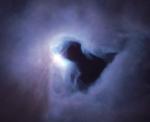 NGC 1999: Reflection Nebula In Orion
1.03.2000
A dusty bright nebula contrasts dramatically with a dusty dark nebula in this Hubble Space Telescope image recorded shortly after December's orbital servicing mission. The nebula, cataloged as NGC 1999, is a reflection nebula, which shines by reflecting light from a nearby star.
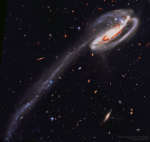 The Tadpole Galaxy from Hubble
20.06.2021
Why does this galaxy have such a long tail? In this stunning vista, based on image data from the Hubble Legacy Archive, distant galaxies form a dramatic backdrop for disrupted spiral galaxy Arp 188, the Tadpole Galaxy. The cosmic tadpole is a mere 420 million light-years distant toward the northern constellation of the Dragon (Draco).
 The Pulsar Powered Crab
31.05.1996
In the Summer of 1054 A.D. Chinese astronomers reported that a star in the constellation of Taurus suddenly became as bright as the full Moon. Fading slowly, it remained visible for over a year.
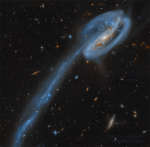 APOD: 2024 July 15 Б The Tadpole Galaxy from Hubble
14.07.2024
Why does this galaxy have such a long tail? In this stunning vista, based on image data from the Hubble Legacy Archive, distant galaxies form a dramatic backdrop for disrupted spiral galaxy Arp 188, the Tadpole Galaxy. The cosmic tadpole is a mere 420 million light-years distant toward the northern constellation of the Dragon (Draco).
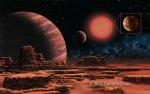 Gliese 876 System Includes Large Terrestrial Planet
14.06.2005
Is our Earth unique? In continuing efforts to answer this question, astronomers have now discovered an Earth-like planet orbiting a distant normal star. Previously over 150 gas-giant planets like Jupiter had been so discovered.
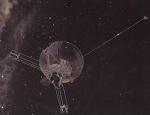 Pioneer 10: The First 6 Billion Miles
20.06.1998
Q: What was made by humans and is 6.5 billion miles away? A: Pioneer 10 - and last year was the 25th anniversary of its launch. More than 9.5 light-hours distant, Pioneer 10 is presently about twice as far from the Sun as Pluto, bound for interstellar space at 28,000 miles per hour.
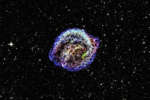 Kepler's Supernova Remnant in X Rays
15.05.2013
What caused this mess? Some type of star exploded to create the unusually shaped nebula known as Kepler's supernova remnant, but which type? Light from the stellar explosion that created this energized cosmic cloud was first seen on planet Earth in October 1604, a mere four hundred years ago.
 M51: Tidal Streams and H-alpha Ciffs
12.12.2024
An intriguing pair of interacting galaxies, M51 is the 51st entry in Charles Messier's famous catalog. Perhaps the original spiral nebula, the large galaxy with whirlpool-like spiral structure seen nearly face-on is also cataloged as NGC 5194. Its spiral arms and dust lanes sweep in front of its smaller companion galaxy, NGC 5195.
|
January February March April May June July August September October |
|||||||||||||||||||||||||||||||||||||||||||||||||