
|
You entered: stars
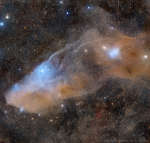 IC 4592: The Blue Horsehead Reflection Nebula
5.07.2021
Do you see the horse's head? What you are seeing is not the famous Horsehead nebula toward Orion but rather a fainter nebula that only takes on a familiar form with deeper imaging. The main part of the here imaged molecular cloud complex is a reflection nebula cataloged as IC 4592.
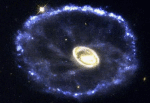 The Cartwheel Galaxy
2.07.1995
The Cartwheel Galaxy shows a ring that is the result of a collision between a small and a large galaxy. After a small galaxy has moved through a big galaxy - in this case...
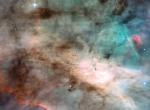 In the Center of the Omega Nebula
1.05.2002
In the depths of the dark clouds of dust and molecular gas known as the Omega Nebula, stars continue to form. The above image from the Hubble Space Telescope's newly installed Advanced Camera for Surveys shows unprecedented detail in the famous star-forming region.
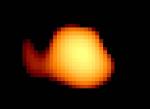 Resolving Mira
13.08.1997
Most stars appear only as points of light. Recently, Betelgeuse became the second star, after our Sun, to have it surface resolved. Now add Mira to the list. Mira A is a red giant star undergoing dramatic pulsations, causing it to become more than 100 times brighter over the course of a year.
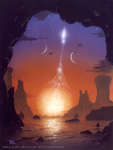 Cataclysmic Dawn
10.01.2015
Will this dawn bring another nova? Such dilemmas might be pondered one day by future humans living on a planet orbiting a cataclysmic variable binary star system. Cataclysmic variables involve gas falling from a large star onto an accretion disk surrounding a massive but compact white dwarf star.
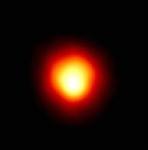 Betelgeuse, Betelgeuse, Betelgeuse
16.02.1997
Betelgeuse (sounds a lot like "beetle juice"), a red supergiant star about 600 light years distant, is seen in this Hubble Space Telescope image -- the first direct picture of the surface of a star other than the Sun. A bright, as yet unexplained hotspot is revealed on its surface!
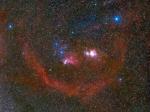 Barnards Loop Around Orion
20.04.2005
Why is the belt of Orion surrounded by a bubble? Although glowing like an emission nebula, the origin of the bubble, known as Barnard's Loop, is currently unknown. Progenitor hypotheses include the winds from bright Orion stars and the supernovas of stars long gone.
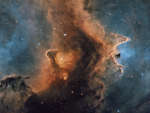 IC 1871: Inside the Soul Nebula
29.10.2015
This cosmic close-up looks deep inside the Soul Nebula. The dark and brooding dust clouds outlined by bright ridges of glowing gas are cataloged as IC 1871. About 25 light-years across, the telescopic field of view spans only a small part of the much larger Heart and Soul nebulae.
 APOD: 2025 December 9 Б The Heart of the Soul Nebula
9.12.2025
This cosmic close-up looks deep inside the Soul Nebula. The dark and brooding dust clouds outlined by bright ridges of glowing gas are cataloged as IC 1871. About 25 light-years across, the telescopic field of view spans only a small part of the much larger Heart and Soul nebulae.
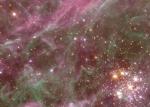 Denizen of the Tarantula Nebula
7.04.1999
The star cluster at lower right, cataloged as Hodge 301, is a denizen of the Tarantula Nebula. An evocative nebula in the southern sky, the sprawling cosmic Tarantula is an energetic star forming region some 168,000 light-years distant in our neighboring galaxy the Large Magellanic Cloud.
|
January February March April May June July August September October |
|||||||||||||||||||||||||||||||||||||||||||||||||