
|
You entered: gas
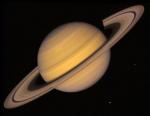 Saturn, Rings, and Two Moons
17.01.1998
NASA's robot spacecraft Voyager 2 made this image of Saturn as it began to explore the Saturn system in 1981. Saturn's famous rings are visible along with two of its moons, Rhea and Dione which appear as faint dots on the right and lower right part of the picture.
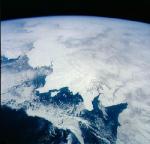 Water World
15.03.1997
Water (Dihydrogen Oxide, H2O) is a truly remarkable chemical compound, fundamental to life on Earth. Earth is the only planet in the Solar System where the surface temperature and pressure allow the three forms of water, solid (ice), liquid (ocean), and gas (water vapor condensing in clouds) to exist simultaneously on its surface.
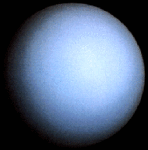 Uranus: The Tilted Planet
16.08.1995
This picture was snapped by the Voyager 2 spacecraft in 1986 - the only spacecraft ever to visit Uranus. Uranus is the third largest planet after Jupiter and Saturn. Uranus has many moons and a ring system.
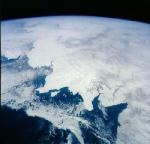 Water World
30.05.1998
Water (Dihydrogen Oxide, H2O) is a truly remarkable chemical compound, fundamental to life on Earth. Earth is the only planet in the Solar System where the present surface temperature and pressure allow the three forms of water, solid (ice), liquid (ocean), and gas (water vapor condensing in clouds) to exist simultaneously.
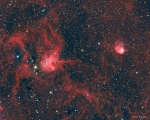 The Spider and The Fly
28.01.2018
Will the spider ever catch the fly? Not if both are large emission nebulas toward the constellation of the Charioteer (Auriga). The spider-shaped gas cloud on the left is actually an emission nebula labelled...
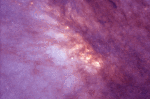 Central Galactic Star Bursts
30.09.1995
The pictured core of the galaxy NGC 253 shows an exceptionally high rate of star formation. In the center are some of the densest knots of stars ever found, surrounded by glowing gas and dust lanes. Galaxies where such high star formation rates are seen are called "starburst" galaxies.
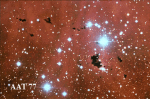 Dark Bok Globules in IC 2944
5.10.1995
The dark spots in the above picture are not photographic defects but an unusual type of interstellar cloud known as a Bok globule. Bok globules, named after astronomer Bart Bok who studied them extensively, are small dark clouds made of gas and dust that are typically condensing to form a star or stars.
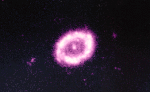 Starburst Galaxy M94
15.10.1995
The spiral galaxy M94 is somewhat unusual in that it shows a great ring of bright young stars particularly apparent when observed in ultraviolet light, as shown above. Such a high abundance of these young blue stars may cause a galaxy to be designated a starburst galaxy.
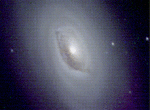 M64: The Sleeping Beauty Galaxy
11.07.1998
The Sleeping Beauty galaxy may appear peaceful at first sight but it is actually tossing and turning. In an unexpected twist, recent observations have shown that the center of this photogenic galaxy is rotating in the opposite direction than the outer regions!
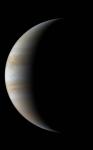 Farewell Jupiter
8.08.2001
Next stop: Saturn. The Cassini spacecraft, launched from Earth four years ago, has now swung past Jupiter and should arrive at Saturn in the year 2004. Pictured to the left is a parting shot from Cassini in January that would not have been possible from Earth: Jupiter showing a crescent phase.
|
January February March April May June July August September October |
|||||||||||||||||||||||||||||||||||||||||||||||||