
|
You entered: gas
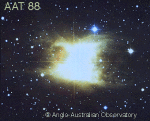 The Toby Jug Nebula
5.01.1996
Is the only thing unusual about this nebula its shape? Pictured above is the IC 2220 - the Toby Jug Nebula - a reflection nebula surrounding a normal red giant star. Reflection nebulae shine by light reflected from the central star(s).
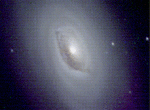 M64: The Sleeping Beauty Galaxy
22.03.1997
The Sleeping Beauty galaxy may appear peaceful at first sight but it is actually tossing and turning. In an unexpected twist, recent observations have shown that the center of this photogenic galaxy is rotating in the opposite direction than the outer regions!
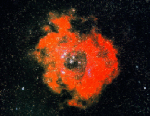 NGC 2237: The Rosette Nebula
14.02.1996
Would the Rosette nebula by any other name look as sweet? The bland New General Catalog designation of NGC 2237 doesn't appear to diminish the appearance of the this flowery emission nebula. Inside the nebula lies an open cluster of bright young stars designated NGC 2244.
 The Sun Erupts
16.09.1996
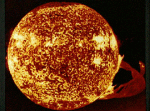
The Sun is a seething ball of extremely hot gas. Above, the Sun was captured by Skylab in 1973 throwing off one the largest eruptive prominences in recorded history. The Sun has survived for about 5 billion years, and will likely survive for another 5 billion.
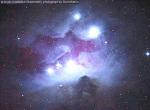 NGC 1977: Blue Reflection Nebula in Orion
22.07.2001
The Orion Nebula is visible to the unaided eye as a fuzzy patch near the famous belt of three stars in the Orion. The above picture captures a part of the Orion Nebula that primarily reflects light from bright Orion stars.
 The Sun Erupts
30.08.1998
The Sun is a seething ball of extremely hot gas. Above, the Sun was captured by Skylab in 1973 throwing off one the largest eruptive prominences in recorded history. The Sun has survived for about 5 billion years, and will likely survive for another 5 billion.
 Water World
18.11.1995
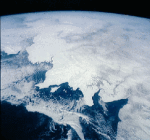
Water (Dihydrogen Oxide, H2O) is a truly remarkable chemical compound and is fundamental to life on Earth. Earth is the only planet in the Solar System where the surface temperature and pressure allow the three forms of water, solid (ice), liquid (ocean), and gas (water vapor condensing in clouds) to exist simultaneously on its surface.
 Orion: The Big Picture
1.12.1997
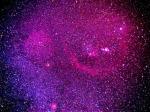
Orion is big. Some of the stars that form the constellation of Orion are part of a giant gas cloud complex that stretches over 100 light years and appears more than 50 times the diameter of the Moon.
 Unusual M82: The Cigar Galaxy
15.03.1998
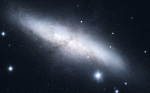
Something strange happened to this galaxy, but what? M82 is a nearby galaxy in the group of galaxies dominated by itself, M81, and NGC 3077. M82 is thought by some to be limping away from a close encounter with M81.
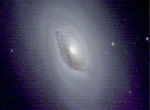 M64: The Sleeping Beauty Galaxy
15.12.1995
The Sleeping Beauty galaxy may appear peaceful at first sight but it is actually tossing and turning. In an unexpected twist, recent observations have shown that the center of this photogenic galaxy is rotating in the opposite direction than the outer regions!
|
January February March April May June July August September October |
|||||||||||||||||||||||||||||||||||||||||||||||||