
|
You entered: planet
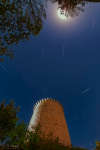 Full Moon Perseids
18.08.2022
The annual Perseid meteor shower was near its peak on August 13. As planet Earth crossed through streams of debris left by periodic Comet Swift-Tuttle meteors rained in northern summer night skies. But even...
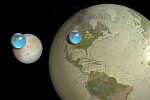 APOD: 2025 October 12 Б All the Water on Europa
12.10.2025
How much of Jupiter's moon Europa is made of water? No one is sure, but probably a lot. Based on the Galileo probe data acquired during its exploration of the Jovian system from 1995 to 2003, Europa possesses a deep, global ocean of liquid water beneath a layer of surface ice.
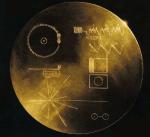 The Voyagers Message in a Bottle
8.09.2007
Launched thirty years ago, NASA's Voyager 1 and 2 spacecraft are now respectively 15 billion and 12.5 billion kilometers from the Sun, equivalent to about 14 and 11.5 light-hours distant. Still functioning, the Voyagers are being tracked and commanded through the Deep Space Network.
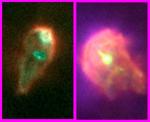 Protoplanetary Survivors in Orion
4.05.2001
The Orion Nebula is a nuturing stellar nursery filled with hot young stars and their natal clouds of gas and dust. But for planetary systems, the active star-forming region can present a hazardous and inhospitable birthplace.
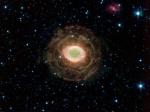 Infrared Ring Nebula
11.03.2005
The classic appearance of the popular Ring Nebula (aka M57) is understood to be due to perspective - our view from planet Earth looks down the center of a roughly barrel-shaped cloud of gas.
APOD: 2025 October 4 Б The Rotating Moon
4.10.2025
No one on Earth sees the Moon rotate like this. That's because the Moon is tidally locked in synchronous rotation, showing only one side to denizens of our fair planet. Still, given modern...
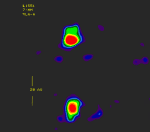 Twin Proto Planetary Disks
25.09.1998
Sun-like stars are forming - and probably planets too - hidden inside Lynds 1551, an interstellar cloud of molecular gas and dust in the constellation Taurus. Using new receivers, coordinated radio telescopes at the Very Large Array near Socorro, New Mexico, USA, can now sharply image the dusty proto-planetary disks surrounding these young stars at radio wavelengths.
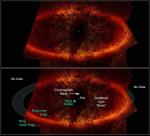 Ring Around Fomalhaut
1.07.2005
Fomalhaut (sounds like "foam-a-lot") is a bright, young, star, a mere 25 light-year trip from planet Earth in the direction of the constellation Piscis Austrinus. Earlier infrared observations identified a torus of cold material...
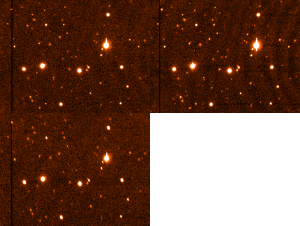 Orcus of the Outer Solar System
25.03.2009
A newly discovered object in the outer Solar System moves like an anti-Pluto. 90482 Orcus was first discovered in 2004 and is slightly smaller than Pluto, although still one of the largest Kuiper belt objects known. Orcus may one day have the same IAU designation as Pluto: a dwarf planet.
 Quadrantids
9.01.2019
Named for a forgotten constellation, the Quadrantid Meteor Shower is an annual event for planet Earth's northern hemisphere skygazers It usually peaks briefly in the cold, early morning hours of January 4. The shower's radiant on the sky lies within the old, astronomically obsolete constellation Quadrans Muralis.
|
January February March April May June July August September October |
|||||||||||||||||||||||||||||||||||||||||||||||||