
|
You entered: planet
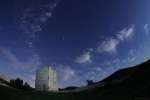 Castle and Meteor by Moonlight
13.08.2011
Each August, as planet Earth swings through dust trailing along the orbit of periodic comet Swift-Tuttle, skygazers enjoy the Perseid Meteor Shower. As Earth moves through the denser part of the comet's wide...
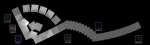 Solar System Portrait
13.02.2015
On another Valentine's Day 25 years ago, cruising four billion miles from the Sun, the Voyager 1 spacecraft looked back one last time to make this first ever Solar System family portrait. The complete portrait is a 60 frame mosaic made from a vantage point 32 degrees above the ecliptic plane.
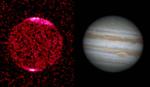 Jupiter s Great X Ray Spot
1.03.2002
The Solar System's largest planet, gas giant Jupiter, is famous for its swirling Great Red Spot. In the right hand panel above, the familiar giant planet with storm system and cloud bands is shown in an optical image from the passing Cassini spacecraft.
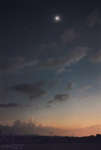 A Total Solar Eclipse of Saros 145
11.08.2017
A darkened sky holds bright planet Venus, the New Moon in silhouette, and the shimmering corona of the Sun in this image of a total solar eclipse. A composite of simultaneous telephoto and wide angle frames it was taken in the path of totality 18 years ago, August 11, 1999, near Kastamonu, Turkey.
 Saturn and Six Moons
6.07.2021
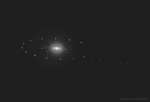
How many moons does Saturn have? So far 82 have been confirmed, the smallest being only a fraction of a kilometer across. Six of its largest satellites can be seen here in a composite...
 Ghosts in Cassiopeia
31.10.2025
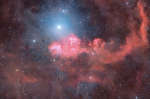
Halloween is an astronomy holiday and spooky shapes always seem to lurk in planet Earth's night skies. In fact, near the center of this telescopic view toward the constellation Cassiopeia these swept-back interstellar clouds IC 59 (left) and IC 63 look ghostly on a cosmic scale.
 Rocket Streak and Star Trails
30.01.2014
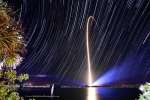
Fixed to a tripod and looking east across the Kennedy Space Center's Turn Basin, a camera captured these star trails as a series of short exposures over a three hour period on the evening of January 23rd.
 Behind Saturn
1.08.2016
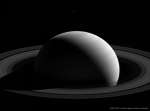
What's behind Saturn? The first answer is the camera itself, perched on the Cassini spacecraft currently orbiting behind the planet with the most grand ring system in our Solar System. The unusual perspective...
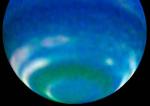 Neptune: Still Springtime After All These Years
13.06.2003
In the 1960s spring came to the southern hemisphere of Neptune, the Solar System's outermost gas giant planet. Of course, since Neptune orbits the Sun once every 165 earth-years, it's still spring for southern Neptune, where each season lasts over four decades.
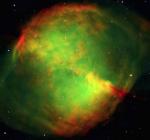 M27: Not A Comet
23.10.1999
While searching the skies above 18th century France for comets, astronomer Charles Messier diligently recorded this object as number 27 on his list of things which are definitely not comets. So what is it?
|
January February March April May June July August September October |
|||||||||||||||||||||||||||||||||||||||||||||||||