
|
You entered: telescope
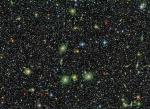 Galaxies Cluster Toward the Great Attractor
4.01.2000
Galaxies dot the sky like jewels in the direction of a mass so large it is known simply as the Great Attractor. The galaxies pictured above are part of a cluster of galaxies called ACO 3627 near the center of the Great Attractor.
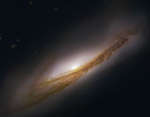 Spiral Galaxy NGC 3190 Almost Sideways
3.05.2010
Some spiral galaxies are seen almost sideways. NGC 3190, one such galaxy, is the largest member of the Hickson 44 Group, one of the nearer groups of galaxies to our own Local Group of galaxies. Pictured above, finely textured dust lanes surround the brightly glowing center of this picturesque spiral.
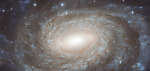 NGC 6384: Spiral Beyond the Stars
22.03.2011
The universe is filled with galaxies. But to see them astronomers must look out beyond the stars of our galaxy, the Milky Way. For example, consider this colorful telescopic view of spiral galaxy NGC 6384, about 80 million light-years away in the direction of the constellation Ophiuchus.
 M51: The Whirlpool Galaxy from Hubble
13.06.2022
The Whirlpool Galaxy is a classic spiral galaxy. At only 30 million light years distant and fully 60 thousand light years across, M51, also known as NGC 5194, is one of the brightest and most picturesque galaxies on the sky.
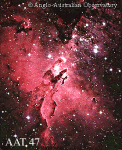 M16: Dust and an Open Cluster
1.11.1995
The photogenic M16 shown above is composed of a young star cluster and a spectacular emission nebulae lined with distinct regions of interstellar dust. Most of the stars in the cluster can be seen offset just above and to the right of the photograph's center.
 Repairing Hubble
16.11.1995
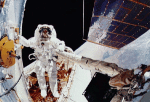
The first Hubble Space Telescope (HST) servicing mission, STS-61, was one of the most complicated shuttle missions ever planned. Launched on December 2, 1993 in the Space Shuttle Endeavor, the astronauts were required to make 5 space walks to repair the HST. Astronaut F.
 Nearby Dwarf Galaxy Leo I
19.05.1996
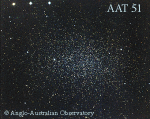
Leo I is a dwarf spheroidal galaxy in the Local Group of galaxies dominated by our Milky Way Galaxy and M31. Leo I is thought to be the most distant of the eleven known small satellite galaxies orbiting our Milky Way Galaxy.
 Seven Jets from Comet Hale-Bopp
13.11.1996
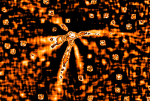
Comet Hale-Bopp is turning out to be quite unusual. One reason is the great amount of jet activity at such a large distance from the Sun. In the above false-color image, no less than seven jets can be seen emanating from Hale-Bopp's coma.
 The Pleiades Star Cluster
27.12.2003
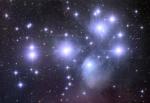
Perhaps the most famous star cluster on the sky, the Pleiades can be seen without binoculars from even the depths of a light-polluted city. Also known as the Seven Sisters and M45, the Pleiades is one of the brightest and closest open clusters.
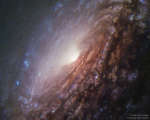 In the Center of Spiral Galaxy NGC 5033
9.01.2017
What's happening in the center of spiral NGC 5033? Many things -- some circular, some energetic, and some not well understood. NGC 5033 is known as a Seyfert galaxy because of the great activity seen in its nucleus.
|
January February March April May June July August September October |
|||||||||||||||||||||||||||||||||||||||||||||||||