
|
You entered: telescope
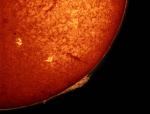 Orange Sun Simmering
29.07.2003
Even a quiet Sun is a busy place. The above image, taken in a single color of light called Hydrogen Alpha, records a great amount of detail of the simmering surface of our parent star.
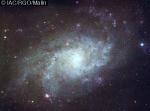 Nearby Spiral M33
21.07.1998
M33 is a prominent nearby spiral galaxy. Nicknamed the Triangulum, M33 is one of the larger members of the Local Group of Galaxies. Two massive spiral galaxies dominate the Local Group: M31 and our Milky Way Galaxy. M33 is the only other spiral galaxy known in the Local Group.
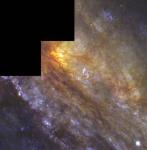 NGC 253: The Sculptor Galaxy
9.12.1998
NGC 253 is not only one of the brightest spiral galaxies visible, it is also one of the dustiest. Discovered in 1783 by Caroline Herschel in the constellation of Sculptor, NGC 253 lies only about ten million light-years distant.
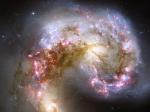 The Antennae Galaxies in Collision
24.10.2006
Two galaxies are squaring off in Corvus and here are the latest pictures. When two galaxies collide, however, the stars that compose them usually do not. This is because galaxies are mostly empty space and, however bright, stars only take up only a small amount of that space.
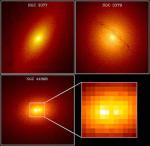 Black Holes in Galactic Centers
17.10.1999
Do all galaxies have black holes at their centers? Although not even a single galaxy has yet been proven to have a central black hole, the list of candidates continues to increase. Results...
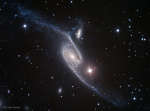 NGC 6872: A Stretched Spiral Galaxy
26.04.2016
What makes this spiral galaxy so long? Measuring over 700,000 light years across from top to bottom, NGC 6872, also known as the Condor galaxy, is one of the most elongated barred spiral galaxies known.
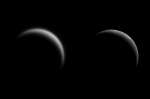 Embraced by Sunlight
3.02.2022
Even though Venus (left) was the brightest planet in the sky it was less than 1/30th the apparent size of the Moon on January 29. But as both rose before the Sun they shared a crescent phase.
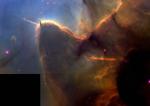 Starbirth in the Trifid Nebula
7.06.1999
Tremendous pillars of gas and dust are being boiled away in the Trifid Nebula. In the center of the picturesque Trifid lies a young hot star, located above and to the right of this picture. As soon as it was born, the massive star scorched its surroundings with bright and
 Maria Mitchell Inspires a Generation
1.10.1997
"Do not look at stars as bright spots only - try to take in the vastness of the universe." Today is the 150th anniversary of the day Maria Mitchell swept the sky with her telescope and discovered the comet of 1847 (comet Mitchell 1847VI).
 The Universe Evolves
30.06.1998
Scroll right and watch the universe evolve. Above is a computer simulation depicting the evolution of our entire universe. On the far left is a slice of the universe soon after the Big Bang - over 10 billion years ago.
|
January February March April May June July August September October |
|||||||||||||||||||||||||||||||||||||||||||||||||