
|
You entered: telescope
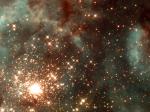 Star Cluster R136 Bursts Out
6.05.2007
In the center of star-forming region 30 Doradus lies a huge cluster of the largest, hottest, most massive stars known. These stars, known as the star cluster R136, and part of the surrounding nebula are captured here in this gorgeous visible-light image from the Hubble Space Telescope.
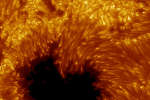 A Sharp View of the Sun
18.09.2011
Here is one of the sharper views of the Sun ever taken. This stunning image shows remarkable details of a dark sunspot across the image bottom and numerous boiling granules which appear like kernels of corn across the top.
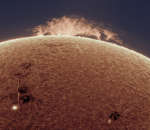 A Prominence on the Sun
18.09.2015
This eerie landscape of incandescent plasma suspended in looping and twisted magnetic fields stretched toward the Sun's eastern horizon on September 16. Captured through a backyard telescope and narrowband filter in light from ionized hydrogen, the scene reveals a gigantic prominence lofted above the solar limb.
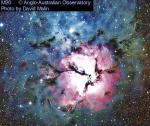 M20: The Trifid Nebula
31.03.1998
Unspeakable beauty and unimaginable bedlam can be found together in the Trifid Nebula. Also known as M20, this photogenic nebula is visible with good binoculars in the constellation of Sagittarius. The energetic processes of star formation create not only the colors but the chaos. The red-glowing gas results from high-energy light striking interstellar hydrogen gas.
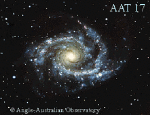 Grand Design Spiral Galaxy NGC 2997
29.10.1996
NGC 2997 is a grand design spiral galaxy. Its small nucleus and sprawling spiral arms give it a type "Sc" designation. NGC 2997 is speeding away from us at about 1100 kilometers...
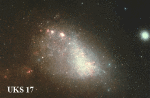 The Small Cloud of Magellan
19.09.1995
Almost unknown to casual observers in the northern hemisphere, the southern sky contains two diffuse wonders known as the Magellanic Clouds. The Magellanic Clouds are small irregular galaxies orbiting our own larger Milky Way spiral galaxy.
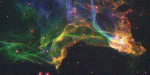 The Cygnus Loop
26.07.1996
15,000 years ago a star in the constellation of Cygnus exploded -- the shockwave from this supernova explosion is still expanding into interstellar space! The collision of this fast moving wall of gas with...
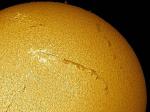 Filaments Across the Sun
5.12.2004
Two unusually long filaments crossed part of the Sun last week. The filaments are actually relatively cool and dark prominences of solar plasma held up by the Sun's magnetic field but seen against the face of the Sun. Filaments typically last a few weeks before falling back.
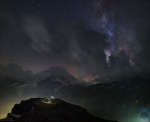 Observatory, Mountains, Universe
29.12.2014
The awesomeness in this image comes in layers. The closest layer, in the foreground, contains the Peak Terskol Observatory located in the northern Caucasus Mountains of Russia. The white dome over the 2-meter telescope is clearly visible. The observatory is located on a shoulder of Mt.
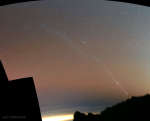 Comet Leonards Long Tail
2.01.2022
You couldn't see Comet LeonardБs extremely long tail with a telescope Б it was just too long. You also couldn't see it with binoculars Б still too long. Or with your eyes -- it was too dim. Or from a city Б the sky was too bright.
|
January February March April May June July August September October |
|||||||||||||||||||||||||||||||||||||||||||||||||