
|
You entered: telescope
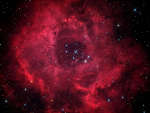 The Rosette Nebula
14.02.2012
The Rosette Nebula is not the only cosmic cloud of gas and dust to evoke the imagery of flowers -- but it is the most famous. At the edge of a large molecular cloud...
 Full Observatory Moon
26.01.2024
A popular name for January's full moon in the northern hemisphere is the Full Wolf Moon. As the new year's first full moon, it rises over Las Campanas Observatory in this dramatic Earth-and-moonscape. Peering from the foreground like astronomical eyes are the observatory's twin 6.5 meter diameter Magellan telescopes.
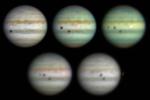 A Triple Eclipse on Jupiter
1.02.1998
Part of Jupiter is missing. Actually, three parts appear to be missing. In reality though, the three dark spots seen in the above photograph are only shadows. The unusual alignment of three of Jupiter's moons between the Jovian giant and the Sun was imaged last November 10th.
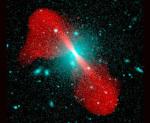 Jets from Radio Galaxy 3C296
25.02.2002
Jets of streaming plasma expelled by the central black hole of a massive elliptical galaxy likely light up this composite image of 3C296. The jets emanating from NGC 5532 and are nearly a million light years long. Exactly how the central black hole expels the infalling matter is still unknown.
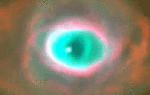 The Eye of an Hourglass Nebula
8.02.1996
What's happening in the eye-like center of this planetary nebula? The geometry revealed in this Hubble Space Telescope view of the central part of an "etched hourglass nebula" known as MyCn 18 presents a puzzle. First, the axis of this central region does not line up well with the outer hourglass structure.
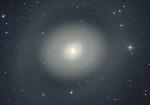 Starburst Galaxy M94
20.11.2002
What could cause the center of M94 to be so bright? Spiral galaxy M94 has a ring of newly formed stars surrounding its nucleus, giving it not only an unusual appearance but also a strong interior glow.
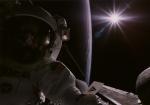 Dark Sky, Bright Sun
17.05.2003
In low Earth orbit there is not enough atmosphere to diffuse and scatter sunlight, so shadows are black and the sky is dark - even when the Sun shines. The harsh lighting produced this dramatic...
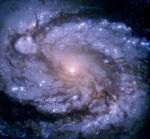 M100: A Grand Design
1.06.1997
Majestic on a truly cosmic scale, M100 is appropriately known as a Grand Design spiral galaxy. A large galaxy of over 100 billion or so stars with well defined spiral arms, it is similar to our own Milky Way.
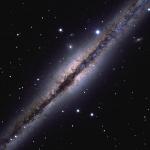 Interstellar Dust Bunnies of NGC 891
17.03.1998
What is going on in NGC 891? This galaxy appeared previously to be very similar to our own Milky Way Galaxy: a spiral galaxy seen nearly edge-on. However, recent high-resolution images of NGC 891's dust show unusual filamentary patterns extending well away from its Galactic disk.
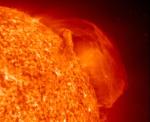 Erupting Sun
18.09.1997
On August 27th twisting magnetic fields propelled this huge eruptive prominence a hundred thousand miles above the Sun's surface. The seething plasma of ionized gases is at a temperature of about 150,000 degrees Farenheit and spans over 200,000 miles (about 27 Earths).
|
January February March April May June July August September October |
|||||||||||||||||||||||||||||||||||||||||||||||||