
|
You entered: telescope
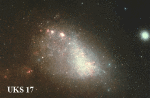 The Small Cloud of Magellan
19.07.1997
The southern sky contains wonders almost unknown in the north. These wonders include the Large and Small Magellanic Clouds: small irregular galaxies orbiting our own larger Milky Way spiral galaxy. The Small Magellanic Cloud (SMC), pictured here, is about 250,000 light years away.
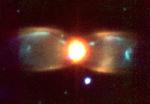 The Butterfly Planetary Nebula
21.10.1997
As stars age, they throw off their outer layers. Sometimes a highly symmetric gaseous planetary nebula is created, as is the case in M2-9, also called the Butterfly. Most planetary nebulae show this bipolar appearance, although some appear nearly spherical.
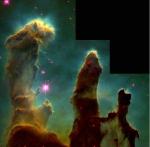 Stars from Eagle's EGGs
12.04.1998
Newborn stars are forming in the Eagle Nebula. This image, taken with the Hubble Space Telescope in 1995, shows evaporating gaseous globules (EGGs) emerging from pillars of molecular hydrogen gas and dust. The giant pillars are light years in length and are so dense that interior gas contracts gravitationally to form stars.
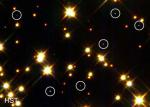 White Dwarf Stars Cool
10.09.2000
Diminutive by stellar standards, white dwarf stars are also intensely hot ... but they are cooling. No longer do their interior nuclear fires burn, so they will continue to cool until they fade away. This Hubble Space Telescope image covers a small region near the center of a globular cluster known as M4.
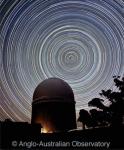 Star Trails in Southern Skies
15.07.2000
As the Earth spins on its axis, the stars seem to rotate around us. This motion produces the beautiful concentric arcs traced out by the stars in this time exposure of the southern hemisphere night sky. In the foreground is the dome of the Anglo-Australian Telescope in central New South Wales, Australia.
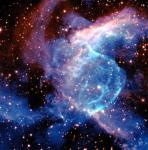 Bubbles and Arcs in NGC 2359
2.01.1997
What caused the bubbles and arcs in NGC 2359? The main suspect is the Wolf-Rayet star in the center of one of the bubbles - visible slightly below and to the right of the center of the above photograph.
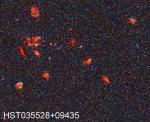 A Cluster Too Far
8.09.1998
Why is this galaxy cluster so red? Nearby clusters have galaxies with colors that are much more yellow and blue. A leading explanation is that this cluster of galaxies lies so far across our universe (z~1) that cosmological time dilation significantly reddens the light.
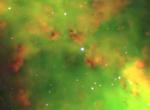 In the Center of the Dumbbell Nebula
13.10.1998
Here's part of the Dumbbell Nebula that you can't see through binoculars. To see this, we suggest a sophisticated spectrograph attached to a telescope with an 8-meter aperture. Pictured above is the central part of the Dumbbell Nebula, also known as M27 and NGC 6853.
 Stars from Eagles Eggs
2.05.1999
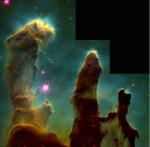
Newborn stars are forming in the Eagle Nebula. This image, taken with the Hubble Space Telescope in 1995, shows evaporating gaseous globules (EGGs) emerging from pillars of molecular hydrogen gas and dust. The giant pillars are light years in length and are so dense that interior gas contracts gravitationally to form stars.
 Tharsis Volcanos
18.06.1999
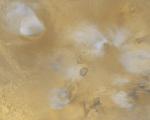
Ice crystal clouds float above the immense Tharsis volcanos of Mars in this recently released picture from NASA's Mars Global Surveyor spacecraft. Olympus Mons at the upper left is 340 miles across and almost 15 miles high - the largest volcano in the solar system.
|
January February March April May June July August September October |
|||||||||||||||||||||||||||||||||||||||||||||||||