
|
You entered: telescope
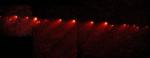 A String Of Pearls
14.08.1999
Comet Shoemaker-Levy 9, named after its co-discoverers, was often referred to as the "string of pearls" comet. It is famous for its suggestive appearance as well as its collision with the planet Jupiter!
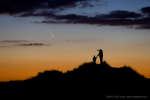 Comet PANSTARRS Just After Sunset
18.03.2013
Have you seen the comet? As Comet PANSTARRS fades, careful observers -- even with unaided eyes -- should still be able to find the shedding ice ball on the western horizon just after sunset. Pictured above, Comet PANSTARRS (C/2011 L4) was pointed out from a hilltop last week on First Encounter Beach in Massachusetts, USA.
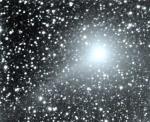 Comet Williams in 1998
6.10.1998
The brightest comet in the sky right now is Comet Williams. Moving slowly though the constellation of Centaurus, Comet Williams, at magnitude 8, is visible to Southern Hemisphere observers with binoculars. In ten days...
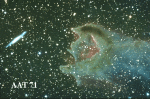 CG4: A Ruptured Cometary Globule
4.10.1995
The odd looking "creature" to the right of center in the above photo is a gas cloud known as a cometary globule. This globule, however, has ruptured. Cometary globules are typically characterized by dusty heads and elongated tails.
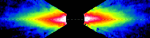 The Dusty Disk of Beta Pic
18.01.1996
This dusty disk, viewed edge on surrounding Beta Pictoris, a star only 50 lightyears distant, may signal the presence of an infant solar system. Beta Pictoris is a young Sun-like star just completing its formative stages.
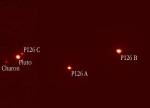 Pluto and Charon Eclipse a Triple Star
11.09.2002
Occasionally, a planet in our Solar System will pass in front of a bright star. Since stars and planets take up so little space on the sky, such events are quite rare. Two months ago, however, Pluto and its large moon Charon passed in front of a comparatively bright triple star system known as P126.
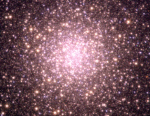 Globular Cluster M3
5.12.1996
This huge ball of stars predates our Sun. Long before mankind evolved, before dinosaurs roamed, and even before our Earth existed, ancient globs of stars condensed and orbited a young Milky Way Galaxy.
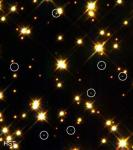 White Dwarf Stars Cool
1.11.1997
Diminutive by stellar standards, white dwarf stars are also intensely hot ... but they are cooling. No longer do their interior nuclear fires burn, so they will continue to cool until they fade away. This Hubble Space Telescope image covers a small region near the center of a globular cluster known as M4.
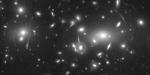 Abell 2218: A Galaxy Cluster Lens
10.01.1998
Gravity can bend light. Almost all of the bright objects in this Hubble Space Telescope image are galaxies in the cluster known as Abell 2218. The cluster is so massive and so compact that its gravity bends and focuses the light from galaxies that lie behind it.
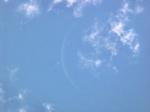 Crescent Venus and Moon
29.10.2006
There's something behind these clouds. Those faint graceful arcs, upon inspection, are actually far, far in the distance. They are the Earth's Moon and the planet Venus. Both the Moon and Venus are bright enough to be seen during the day, and both are quite capable of showing a crescent phase.
|
January February March April May June July August September October |
|||||||||||||||||||||||||||||||||||||||||||||||||