
|
You entered: telescope
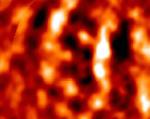 Cosmic Ripples Implicate Dark Universe
29.05.2002
What may appear fuzzy to some makes things crystal clear to others. The cosmic microwave background radiation emanating from the universe could only have the above fuzzy pattern if it contained clear amounts of dark matter and dark energy.
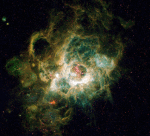 NGC 604: Giant Stellar Nursery in M33
16.08.1996
The nebula cataloged as NGC 604 is a giant star forming region, 1500 light years across, in the nearby spiral galaxy, M33. Seen here in a snapshot by the Hubble Space Telescope, over 200 newly formed, hot, massive, stars are scattered within a cavern-like, gaseous, interstellar cloud.
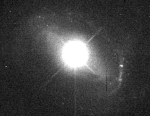 Why is QSO 1229+204 so Bright?
24.08.1996
What causes the center of this barred spiral galaxy to light up brighter than almost anything in the universe? The quasar there is a good fraction of the way across our observable universe...
 Carl Sagan 1934-1996
25.12.1996
Carl Sagan died last Friday at the age of 62. Sagan was the world's most famous astronomer. Among his many activities as a scientist, he contributed to the discovery that the atmosphere...
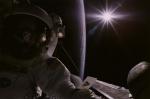 Dark Sky, Bright Sun
2.09.1997
In low Earth orbit there is not enough atmosphere to diffuse and scatter sunlight, so shadows are black and the sky is dark - even when the Sun shines. The harsh lighting produced this dramatic...
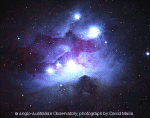 NGC 1977: Blue Reflection Nebula in Orion
31.01.1998
The Orion Nebula is visible to the unaided eye as a fuzzy patch near the famous belt of three stars in the constellation Orion. The above picture captures a part of the Orion Nebula that primarily reflects light from bright Orion stars.
 Eclipse in Seven
10.04.2024
Start at the upper left above and you can follow the progress of April 8's total eclipse of the Sun in seven sharp, separate exposures. The image sequence was recorded with a telescope and camera located within the narrow path of totality as the Moon's shadow swept across Newport, Vermont, USA.
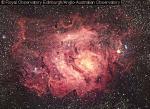 M8: The Lagoon Nebula
7.07.1998
The bright Lagoon Nebula is home to a diverse array of astronomical objects. Particularly interesting sources include a bright open cluster of stars and several energetic star-forming regions. The general red glow is caused by luminous hydrogen gas, while the dark filaments are caused by absorption by dense lanes of dust.
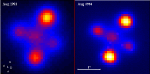 Microlensing of the Einstein Cross
14.12.1996
The famous "Einstein Cross" is a case where a single object is seen four times. Here a very distant QSO happened to be placed right behind a massive galaxy. The gravitational effect...
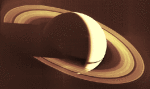 The Night Side of Saturn
5.07.1995
This image of Saturn was made in November 1980 by the Voyager 1 spacecraft as it flew past the ringed gas giant planet. From a spectacular vantage point, looking back toward the inner solar system, the robot spacecraft recorded this view of the night side of Saturn casting a sharp shadow across the bright rings.
|
January February March April May June July August September October |
|||||||||||||||||||||||||||||||||||||||||||||||||