
|
You entered: telescope
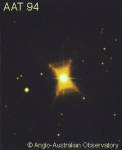 The Red Rectangle
2.11.1995
The unusual geometry of this stellar nebula creates somewhat of a mystery. At the nebula's center is a young binary star system that probably created the nebula, but how? This type of nebula shows a "bipolar flow" which carries a significant amount of mass away from the central stars.
 Wild Duck Open Cluster M11
16.01.1996
Many stars like our Sun were formed in open clusters. The above open cluster, M11, contains thousands of stars and is just over three thousand light years distant. The stars in this cluster all formed together about 150 million years ago. The many bright stars in the cluster appear blue.
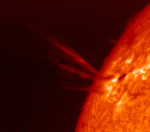 A Solar Corona Ejection
8.11.1996
The Sun would not be a nice place to spend the summer. One reason, besides the extreme heat, is that explosions are common there. In the above picture, magnetic fields buckle releasing previously constrained hot material from the upper atmosphere of the Sun.
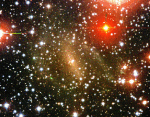 Galaxy Dwingeloo 1 Emerges
1.03.1997
Sometimes you can't see the forest for the trees. But if you look closely at the center of the above photograph, you will see a whole spiral galaxy behind the field of stars.
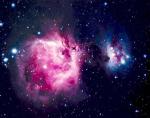 The Great Nebula in Orion
27.01.1998
The Great Nebula in Orion can be found just below and to the left of the easily identifiable belt of three stars in the popular constellation Orion. This fuzzy patch contains one of the closest stellar nurseries, lying at a distance of about 1500 light years.
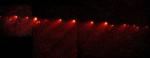 A String Of Pearls
1.08.1998
Comet Shoemaker-Levy 9, named after its co-discoverers, was often referred to as the "string of pearls" comet. It is famous for its suggestive appearance as well as its collision with the planet Jupiter!
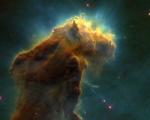 Eagle Eggs in M16
28.02.1998
Star forming regions known as "EGGs" are uncovered at the end of this giant pillar of gas and dust in the Eagle Nebula (M16). EGGs, short for evaporating gaseous globules, are dense regions of mostly molecular hydrogen gas that fragment and gravitationally collapse to form stars.
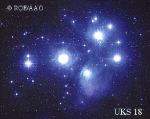 The Pleiades Star Cluster
25.10.1998
It is the most famous star cluster on the sky. The Pleiades can be seen without binoculars from even the depths of a light-polluted city. Also known as the Seven Sisters and M45, the Pleiades is one of the brightest and closest open clusters.
 The Pleiades Star Cluster
18.10.1997
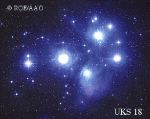
It is the most famous star cluster on the sky. The Pleiades can be seen without binoculars from even the depths of a light-polluted city. Also known as the Seven Sisters and M45, the Pleiades is one of the brightest and closest open clusters.
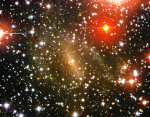 Galaxy Dwingeloo 1 Emerges
2.08.1998
Sometimes you can't see the forest for the trees. But if you look closely at the center of the above photograph, you will see a whole spiral galaxy behind the field of stars.
|
January February March April May June July August September October |
|||||||||||||||||||||||||||||||||||||||||||||||||