
|
You entered: telescope
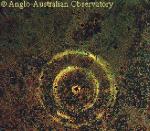 Echoes of Supernova 1987A
23.10.1997
Can you find Supernova 1987a? It's not hard - it occurred in the center of the bulls-eye pattern. Although this stellar detonation was seen more than a decade ago, light from it continues to bounce off nearby interstellar dust and be reflected to us. These two rings are thus echoes of the powerful supernova.
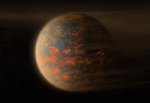 Cancri 55 e: Climate Patterns on a Lava World
5.04.2016
Why might you want to visit super-earth Cancri 55 e? Its extremely hot climate would be a deterrent, as mornings on this world might bring fresh lava flows. Discovered in 2004, the planet Cancri 55 e has twice the diameter of our Earth and about 10 times Earth's mass.
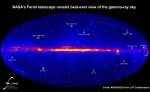 Fermi s Gamma Ray Sky
21.03.2009
Scanning the entire sky in gamma-rays, photons with over 50 million times the energy of visible light, the Fermi mission's Large Area Telescope (LAT) explores the high-energy universe. This all-sky map constructed from...
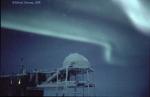 Aurora Over Antarctica
20.03.2002
Looking out from the bottom of the world, strange and spectacular sights are sometimes observed. Such was the case during the long Antarctic night of 1998, as awesome aurora sub-storms were photographed above scientific outposts. Visible in the left foreground of the above photograph is the Martin A.
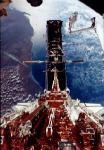 Orbiting Repairmen
28.01.1996
In December of 1993 astronauts Story Musgrave and Jeffrey Hoffman performed the orbiting repairmans' ballet 400 miles above the Earth. They are seen in this photo perched at the end of the Space Shuttle Endeavour's robotic arm making final repairs to the four story tall Hubble Space Telescope.
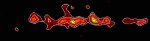 Radioactive Clouds in the Milky Way
29.10.1995
When massive stars explode they create large radioactive blast clouds which expand into interstellar space. As the radioactive elements decay, they produce gamma-rays. Possible locations of these stellar explosions known as supernovae, are indicated by the bright clumps in this map of the central regions of our Milky Way Galaxy.
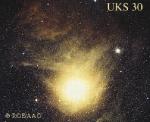 Antares
24.06.1997
Antares is a huge star. In a class called red supergiant, Antares is about 700 times the size of our own Sun, 15 times more massive, and 10,000 times brighter. Antares is the brightest star in the constellation of Scorpius and one of the brighter stars in all the night sky.
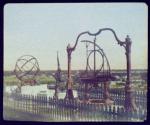 Beijing Ancient Observatory
6.05.1998
Did observatories exist before telescopes? One example that still stands today is the Beijing Ancient Observatory in China. Starting in the 1400s astronomers erected large instruments here to enable them to measure star and planet positions with increasing accuracy.
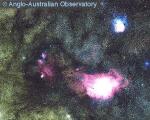 The Sky Towards Sagittarius
7.09.1998
A variety of stars and nebulae can be found towards the constellation of Sagittarius. Dense fields of stars laced with dark lanes of dust crowd this region only a few degrees from the center of our Galaxy.
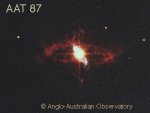 Symbiotic Star System R Aquarii
4.01.1996
Sometimes stars work together to create a spectacular display. Such is the case with the binary star system R Aquarii - a "symbiotic" star system. Here two stars, a variable giant and a white dwarf companion - create both a nebula and a jet.
|
January February March April May June July August September October |
|||||||||||||||||||||||||||||||||||||||||||||||||