
|
You entered: telescope
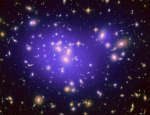 Galaxy Cluster Abell 1689 Magnifies the Dark Universe
24.08.2010
What's the matter with this cluster of galaxies? To find out what forms matter takes in the Abell 1689 cluster requires not only deep images from telescopes like the Hubble Space Telescope, but detailed computer modeling as well. To start, almost every fuzzy yellow patch in the above image is an entire galaxy.
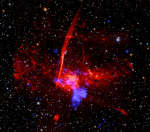 APOD: 2026 June 18 Б Possible Supernova Remnant in Galactic Center
18.06.2026
Do you see that blue blob to the lower right of the image center? Astronomers think that it shows where a massive star exploded as a supernova whose light reached Earth 1,700 years ago.
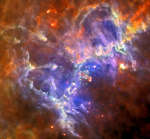 Inside the Eagle Nebula
3.02.2012
In 1995, a now famous picture from the Hubble Space Telescope featured Pillars of Creation, star forming columns of cold gas and dust light-years long inside M16, the Eagle Nebula. This remarkable false-color composite image revisits the nearby stellar nursery with image data from the orbiting Herschel Space Observatory and XMM-Newton telescopes.
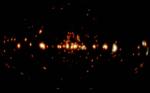 A Mystery in Gamma Rays
3.04.2004
Gamma rays are the most energetic form of light, packing a million or more times the energy of visible light photons. If you could see gamma rays, the familiar skyscape of steady stars would be replaced by some of the most bizarre objects known to modern astrophysics -- and some which are unknown.
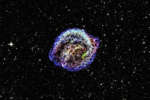 Kepler's Supernova Remnant in X Rays
15.05.2013
What caused this mess? Some type of star exploded to create the unusually shaped nebula known as Kepler's supernova remnant, but which type? Light from the stellar explosion that created this energized cosmic cloud was first seen on planet Earth in October 1604, a mere four hundred years ago.
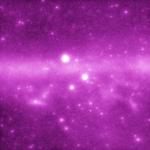 GLAST Gamma Ray Sky Simulation
12.11.1998
This simulated image models the intensities of gamma rays with over 40 million times the energy of visible light, and represents how the sky might appear to the proposed Gamma-ray Large Area Space Telescope (GLAST) after its first year in orbit.
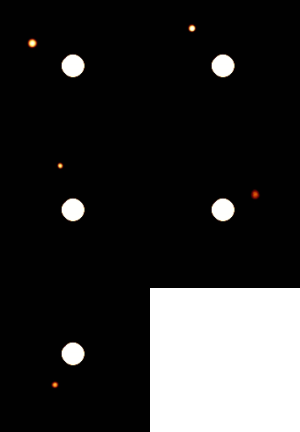 Moon Over Eugenia
14.10.1999
Eugenia is an asteroid with a moon! This animation was constructed from infrared discovery images of the Eugenia-moon system taken in November 1998 using the Canada-France-Hawaii Telescope (CFHT). Main belt asteroid Eugenia, represented here as a central white patch, is a mere 215 kilometers in diameter.
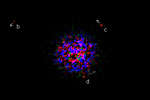 HR 8799: Discovery of a Multi planet Star System
17.11.2008
How common are planetary systems like our own Solar System? In the twelve years previous to 2008, over 300 candidate planetary systems have been found orbiting nearby stars. None, however, were directly imaged, few showed evidence for multiple planets, and many had a Jupiter-sized planet orbiting inside the orbit of Mercury.
 Distant Galaxies
22.06.1997
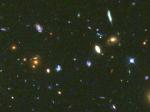
This Hubble Space Telescope image of a group of faint galaxies "far, far away" is a snap shot of the Universe when it was young. The bluish, irregularly shaped galaxies revealed in the image are up to eight billion light years away and seem to have commonly undergone galaxy collisions and bursts of star formation.
 A Distant Cluster of Galaxies
14.01.1996
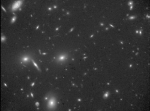
Every bright object in this 1994 photograph by the Hubble Space Telescope is a galaxy. Oddly - most of the objects are spiral galaxies. This rich cluster of galaxies, named CL 0939+4713, is almost half way across the visible universe.
|
January February March April May June July August September October |
|||||||||||||||||||||||||||||||||||||||||||||||||