
|
You entered: telescope
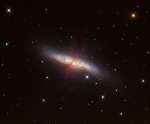 Bright Supernova in M82
24.01.2014
Astronomers really don't find supernovae by looking for the arrows. But in this image taken January 23rd, an arrow does point to an exciting, new supernova, now cataloged as SN 2014J, in nearby bright galaxy M82.
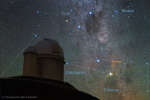 Closest Star has Potentially Habitable Planet
25.08.2016
The star closest to the Sun has a planet similar to the Earth. As announced yesterday, recent observations confirmed that this planet not only exists but inhabits a zone where its surface temperature could allow liquid water, a key ingredient for life on Earth.
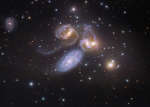 Stephan s Quintet Plus One
27.03.2014
The first identified compact galaxy group, Stephan's Quintet is featured in this remarkable image constructed with data drawn from Hubble Legacy Archive and the Subaru Telescope on the summit of Mauna Kea.
 The Tarantula Zone
8.03.2024
The Tarantula Nebula, also known as 30 Doradus, is more than a thousand light-years in diameter, a giant star forming region within nearby satellite galaxy the Large Magellanic Cloud. About 180 thousand light-years away, it's the largest, most violent star forming region known in the whole Local Group of galaxies.
 APOD: 2025 August 9 Б Interstellar Interloper 3I/ATLAS from Hubble
9.08.2025
Discovered on July 1 with the NASA-funded ATLAS (Asteroid Terrestrial-impact Last Alert System) survey telescope in Rio Hurtado, Chile, 3I/ATLAS is so designated as the third known interstellar object to pass through our Solar System. It follows 1I/йOumuamua in 2017 and the comet 2I/Borisov in 2019.
 Zeta Oph: Runaway Star
4.01.2024
Like a ship plowing through cosmic seas, runaway star Zeta Ophiuchi produces the arcing interstellar bow wave or bow shock seen in this stunning infrared portrait. In the false-color view, bluish Zeta...
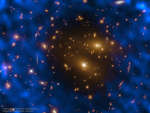 Galaxy Cluster Gas Creates Hole in Microwave Background
10.04.2017
Why would this cluster of galaxy punch a hole in the cosmic microwave background (CMB)? First, the famous CMB was created by cooling gas in the early universe and flies right through most gas and dust in the universe. It is all around us.
 Caught in the Afterglow
24.11.2011
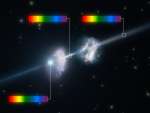
In this artist's illustration, two distant galaxies formed about 2 billion years after the big bang are caught in the afterglow of GRB090323, a gamma-ray burst seen across the Universe. Shining through...
 A Cosmic Call to Nearby Stars
9.01.2001
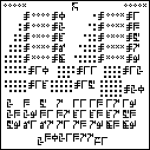
If you could send a message to an alien civilization, what would you say? The people from the Cosmic Call project sent the above image as the first page of a longer message. The message was broadcast toward local stars by a radio telescope in
 X Ray Stars of 47 Tucanae
24.05.2001
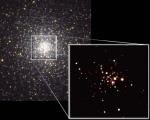
A deep optical image (left) of 47 Tucanae shows an ancient globular star cluster so dense and crowded that individual stars can not be distinguished in its closely packed core. An x-ray image of its central regions (inset right) from the Chandra Observatory reveals a wealth of x-ray stars hidden there.
|
January February March April May June July August September October |
|||||||||||||||||||||||||||||||||||||||||||||||||