
|
You entered: telescope
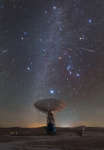 Geminids of the North
15.12.2017
Earth's annual Geminid meteor shower did not disappoint as our fair planet plowed through dust from active asteroid 3200 Phaethon. Captured in this northern hemisphere nightscape, the meteors stream away from the shower's radiant in Gemini.
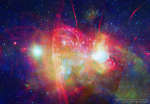 The Galactic Center from Radio to X ray
31.03.2020
In how many ways does the center of our Galaxy glow? This enigmatic region, about 26,000 light years away toward the constellation of the Archer (Sagittarius), glows in every type of light that we can see.
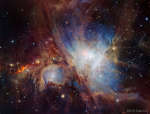 The Orion Nebula in Infrared from HAWK I
18.07.2016
The deepest infrared image of the Orion Nebula has uncovered a bonanza of previously unknown low-mass stars and -- quite possibly -- free floating planets. The picturesque nebula is best known in visible light where it shows a many bright stars and bright glowing gas.
 GRB 221009A
15.10.2022
Gamma-ray burst GRB 221009A likely signals the birth of a new black hole, formed at the core of a collapsing star long ago in the distant universe. The extremely powerful blast is depicted in this animated gif constructed using data from the Fermi Gamma Ray Space Telescope.
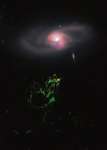 Hanny s Voorwerp
10.02.2011
Hanny's Voorwerp, Dutch for "Hanny's Object", is enormous, about the size of our own Milky Way Galaxy. Glowing strongly in the greenish light produced by ionized oxygen atoms, the mysterious voorwerp is below spiral galaxy IC 2497 in this view from the Hubble Space Telescope.
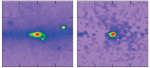 Gamma Rays from Galactic Center Dark Matter
10.03.2014
What is creating the gamma rays at the center of our Galaxy? Excitement is building that one answer is elusive dark matter. Over the past few years the orbiting Fermi Gamma-ray Space Telescope has been imaging our Galaxy's center in gamma-rays.
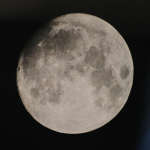 21st Century Wet Collodion Moon
2.01.2021
In the mid 19th century, one of the first photographic technologies used to record the lunar surface was the wet-plate collodion process, notably employed by British astronomer Warren De la Rue. To capture...
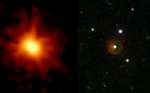 Across the Universe
28.03.2008
How far can you see? Even the faintest stars visible to the eye are merely hundreds or thousands of light-years distant, all well within our own Milky Way Galaxy. Of course, if you know where to look you can also spot the Andromeda Galaxy as a pale, fuzzy cloud, around 2.5 million light-years away.
 Tychos Supernova Remnant
17.03.2009
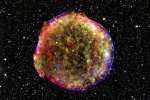
What star created this huge puffball? Pictured above is the best multi-wavelength image yet of Tycho's supernova remnant, the result of a stellar explosion first recorded over 400 years ago by the famous astronomer Tycho Brahe.
 Two Hemisphere Night Sky
27.02.2020
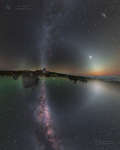
The Sun is hidden by a horizon that runs across the middle in this two hemisphere view of Earth's night sky. The digitally stitched mosaics were recorded from corresponding latitudes, one 29 degrees north and one 29 degrees south of the planet's equator.
|
January February March April May June July August September October |
|||||||||||||||||||||||||||||||||||||||||||||||||