
|
You entered: telescope
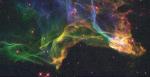 The Cygnus Loop
25.07.1999
The shockwave from a 20,000 year-old supernova in the constellation of Cygnus supernova explosion is still expanding into interstellar space. The collision of this fast moving wall of gas with a stationary cloud...
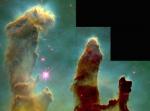 M16: Stars from Eagles EGGs
26.10.2003
Newborn stars are forming in the Eagle Nebula. This image, taken with the Hubble Space Telescope in 1995, shows evaporating gaseous globules (EGGs) emerging from pillars of molecular hydrogen gas and dust. The giant pillars are light years in length and are so dense that interior gas contracts gravitationally to form stars.
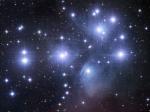 M45: The Pleiades Star Cluster
8.01.2006
Perhaps the most famous star cluster on the sky, the Pleiades can be seen without binoculars from even the depths of a light-polluted city. Also known as the Seven Sisters and M45, the Pleiades is one of the brightest and closest open clusters.
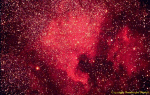 The North America Nebula
6.06.1996
Here's a familiar shape in an unfamiliar location! This emission nebula is famous partly because it resembles Earth's North American Continent. To the right of the North America Nebula is a less luminous Pelican Nebula. Let's be grateful that pelicans aren't really that large!
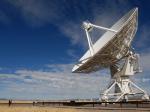 A Big Dish at the VLA Radio Observatory
28.11.2006
They are so large, they are almost unreal. The radio dishes of the Very Large Array (VLA) of radio telescopes might appear to some as a strange combination of a dinosaur skeleton and common satellite-TV receiving dish.
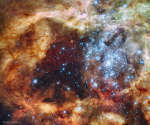 Star Cluster R136 Breaks Out
9.01.2021
In the center of nearby star-forming region lies a huge cluster containing some of the largest, hottest, and most massive stars known. These stars, known collectively as star cluster R136, part of the Tarantula Nebula, were captured in the featured image in visible light in 2009 through the Hubble Space Telescope.
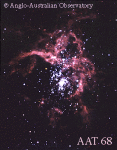 The Violent Star Cluster 30 Doradus
23.05.1996
The largest, most violent star forming region known in the whole Local Group of galaxies lies in our neighboring galaxy the LMC. Were 30 Doradus at the distance of the Orion Nebula -- a local star forming region -- it would take up fully half the sky.
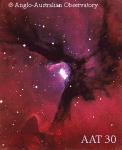 Hot Stars in the Trifid Nebula
20.12.1995
In the center of the glowing red gas on the Trifid Nebula lies an open cluster of young hot stars. The energetic light from these stars strikes hydrogen atoms in the surrounding nebula causing them to lose their electrons.
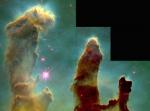 M16: Stars from Eagle's EGGs
24.04.2005
Newborn stars are forming in the Eagle Nebula. This image, taken with the Hubble Space Telescope in 1995, shows evaporating gaseous globules (EGGs) emerging from pillars of molecular hydrogen gas and dust. The giant pillars are light years in length and are so dense that interior gas contracts gravitationally to form stars.
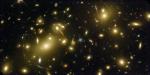 Abell 2218: A Galaxy Cluster Lens
31.01.2000
Gravity can bend light. Almost all of the bright objects in this recently released Hubble Space Telescope image are galaxies in the cluster known as Abell 2218. The cluster is so massive and so compact that its gravity bends and focuses the light from galaxies that lie behind it.
|
January February March April May June July August September October |
|||||||||||||||||||||||||||||||||||||||||||||||||