
|
You entered: telescope
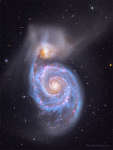 APOD: 2026 January 14 Б M51: The Whirlpool Galaxy
14.01.2026
The Whirlpool Galaxy is a classic spiral galaxy. At only 30 million light years distant and fully 60 thousand light years across, M51, also known as NGC 5194, is one of the brightest and most picturesque galaxies on the sky.
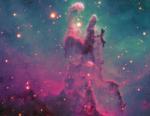 Eagle Castle
30.07.1997
What lights up this castle of star formation? The familiar Eagle Nebula glows much like a neon sign, but in many colors at once. The above photograph is a composite of three of these glowing gas colors.
 A Distant Destiny
14.01.1998
Watching galaxies recede, observational astronomers of the 20th century discovered an astounding fact - the Universe is expanding. Will it continue to expand forever? The speed of light is finite so looking into the distant Universe is equivalent to looking at the distant past.
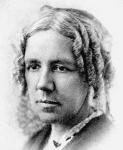 Maria Mitchell Inspires a Generation
10.10.1998
"Do not look at stars as bright spots only - try to take in the vastness of the universe." October 1st was the 151st anniversary of the day Maria Mitchell swept the sky with her telescope and discovered the comet of 1847 (comet Mitchell 1847VI).
 Zooming in to the Pelican Nebula
2.07.2007
Where on the sky is the Pelican Nebula? APOD features many objects on the night sky, but usually does not have the resources to show exactly where on the night sky each objects lies.
 Sunlight Through Saturns Rings
24.06.2000
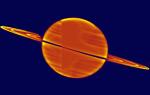
Normally, earth-bound astronomers view Saturn's spectacular ring system fully illuminated by reflected sunlight. However, this intriguing picture was made to take advantage of an unusual orientation, with the Sun actually illuminating the rings from below. The three bright ring features are visible because the rings themselves are not solid.
 Saturn with Moons Tethys and Dione
31.05.1997
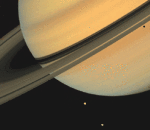
Saturn and two of its larger moons - Tethys and Dione - were photographed by the Voyager 1 spacecraft which flew by the planet in November of 1980. This picture gives an indication of Saturn's extensive ring system, which can be seen casting a shadow on the planet, as does Tethys.
 NGC 7635: The Bubble Nebula
17.11.1998
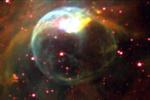
What created this huge space bubble? A massive star that is not only bright and blue, but also emitting a fast stellar wind of ionized gas. The Bubble Nebula is actually the smallest...
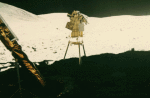 The First Lunar Observatory
8.06.1996
The first and only lunar astronomical observatory was deployed by the Apollo 16 crew in 1972. The Far Ultraviolet Camera / Spectrograph used a 3-inch diameter telescope to photograph the Earth, various nebulae, star clusters, and the Large Magellanic Cloud.
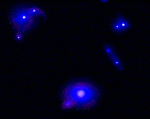 Two Billion Years After the Big Bang
7.09.1996
What did the universe look like two billion years after the Big Bang? According to this computer model, the universe was filled with irregular looking objects like the ones shown above. The simulation then predicts that these blobs of stars and gas collide to form galaxies more similar to the ones we see today.
|
January February March April May June July August September October |
|||||||||||||||||||||||||||||||||||||||||||||||||