
|
You entered: unusual
 APOD: 2023 August 9 Б Meteor Shower: Perseids from Perseus
9.08.2023
This is a good week to see meteors. Comet dust will rain down on planet Earth, streaking through dark skies during peak nights of the annual Perseid Meteor Shower. The featured composite image was taken during the 2018 Perseids from the Poloniny Dark Sky Park in Slovakia.
 APOD: 2023 September 18 Б The Red Sprite and the Tree
18.09.2023
The sprite and tree could hardly be more different. To start, the red sprite is an unusual form of lightning, while the tree is a common plant. The sprite is far away -- high in Earth's atmosphere, while the tree is nearby -- only about a football field away.
 APOD: 2024 February 26 Б Martian Moon Eclipses Martian Moon
26.02.2024
What if there were two moons in the sky -- and they eclipsed each other? This happens on Mars. The featured video shows a version of this unusual eclipse from space. Pictured are the two moons of Mars: the larger Phobos, which orbits closer to the red planet, and the smaller Deimos, which orbits further out.
 APOD: 2025 April 16 Б Halo of the Cats Eye
16.04.2025
What created the unusual halo around the Cat's Eye Nebula? No one is sure. What is sure is that the Cat's Eye Nebula (NGC 6543) is one of the best known planetary nebulae on the sky.
 APOD: 2025 July 27 Б Lightning over the Volcano of Water
27.07.2025
Have you ever watched a lightning storm in awe? You're not alone. Details of what causes lightning are still being researched, but it is known that inside some clouds, internal updrafts cause collisions between ice and snow that slowly separate charges between cloud tops and bottoms.
 APOD: 2026 May 3 Б Trifid Pillars and Jets
3.05.2026
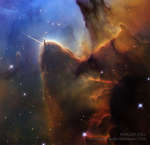
Dust pillars are like interstellar mountains. They survive because they are more dense than their surroundings, but they are slowly being eroded away by a hostile environment. Visible in the featured picture...
 HET: The New Largest Optical Telescope
27.12.1996
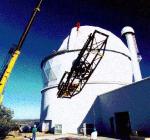
Most of our universe is too dim to see. To peer into our cosmos' unknown depths, astronomers must deploy new tools - and the classic new tool is a larger telescope. Pictured above is the new Hobby-Eberly Telescope (HET) which recently declared "first light" in western Texas.
 Comet Wild 2s Nucleus from Stardust
3.01.2004
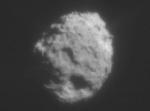
What does a comet nucleus look like? Yesterday the robot spacecraft Stardust answered this question by returning the most detailed images yet of the center of a comet. The icy centers of comets are usually hidden from Earth-bound telescopes by opaque dust and gas that boils off during approach to the Sun.
 Mercury on the Horizon
27.01.2008
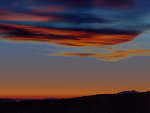
Have you ever seen the planet Mercury? Because Mercury orbits so close to the Sun, it never wanders far from the Sun in Earth's sky. If trailing the Sun, Mercury will be visible low on the horizon for only a short while after sunset.
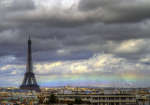 A Horizon Rainbow in Paris
27.03.2013
Why is this horizon so colorful? Because, opposite the Sun, it is raining. What is pictured above is actually just a common rainbow. It's uncommon appearance is caused by the Sun being unusually high in the sky during the rainbow's creation.
|
January February March April May June July August |
||||||||||||||||||||||||||||||||||||||||||||||||||||||||