
|
You entered: unusual
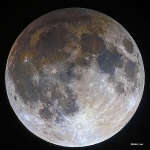 Penumbral Lunar Eclipse
12.10.2016
Does this Moon look a little different to you? Although shown in spectacular detail, the full face of Earth's most familiar satellite appears slightly darker than usual, in particular on the upper left, because it is undergoing a penumbral lunar eclipse.
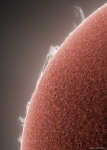 Active Prominences on a Quiet Sun
20.08.2018
Why is the Sun so quiet? As the Sun enters into a period of time known as a Solar Minimum, it is, as expected, showing fewer sunspots and active regions than usual. The quietness is somewhat unsettling, though, as so far this year, most days show no sunspots at all.
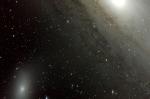 Dwarf Elliptical Galaxy NGC 205 in the Local Group
23.10.2000
Our Milky Way Galaxy is not alone. It is part of a gathering of about 25 galaxies known as the Local Group. Members include the Great Andromeda Galaxy (M31), M32, M33, the Large Magellanic Cloud, the Small Magellanic Cloud, Dwingeloo 1, several small irregular galaxies, and many dwarf elliptical and dwarf spheroidal galaxies.
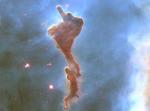 Disappearing Clouds in Carina
30.06.2003
This dense cloud of gas and dust is being deleted. Likely, within a few million years, the intense light from bright stars will have boiled it away completely. Stars not yet formed in the molecular cloud's interior will then stop growing.
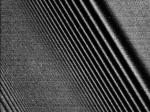 Cassini Images Density Waves in Saturns Rings
5.07.2004
What causes the patterns in Saturn's rings? The Cassini spacecraft just entering orbit around Saturn has started sending back spectacular images of Saturn's immense ring system in unprecedented detail. The physical cause for many of newly resolved ring structures is not always understood.
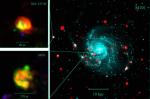 Candidates for a Hypernova
20.04.1999
What created these huge explosion remnants? Speculation has been building recently that outbursts even more powerful than well-known supernovae might occur. Dubbed hypernovae, these explosions might result from high-mass stars and liberate perhaps ten times more energy than conventional supernovae.
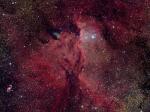 Reflections on NGC 6188
1.06.2006
NGC 6188 is an interstellar carnival of young blue stars, hot red gas, and cool dark dust. Located 4,000 light years away in the disk of our Galaxy, NGC 6188 is home to the Ara OB1 association, a group of bright young stars whose nucleus forms the open cluster NGC 6193.
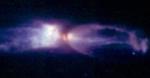 The Rotten Egg Planetary Nebula
1.11.1999
Not all evolving stars eject gas clouds that look like people. OH231.8+4.2 was a star much like our Sun that ran out of nuclear fuel to fuse in its core.
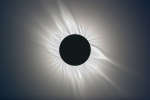 The Big Corona
26.07.2009
Most photographs don't adequately portray the magnificence of the Sun's corona. Seeing the corona first-hand during a total solar eclipse is best. The human eye can adapt to see features and extent that photographic film usually cannot. Welcome, however, to the digital age.
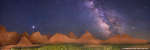 The Milky Way Over the Badlands
18.08.2009
Why take a picture of just the Badlands when you can take one that also shows the spectacular sky above it? Just such a picture, actually a digital stitched panorama of four images, was taken in late June near midnight, looking southwest.
|
January February March April May June July August |
||||||||||||||||||||||||||||||||||||||||||||||||||||||||