
|
You entered: unusual
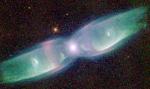 M2 9: Wings of a Butterfly Nebula
1.02.2004
Are stars better appreciated for their art after they die? Actually, stars usually create their most artistic displays as they die. In the case of low-mass stars like our Sun and M2-9 pictured above, the stars transform themselves from normal stars to white dwarfs by casting off their outer gaseous envelopes.
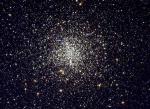 M4: The Closest Known Globular Cluster
23.05.2000
M4 is a globular cluster visible in dark skies about one degree west of the bright star Antares in the constellation Scorpius. M4 is perhaps the closest globular cluster at 7000 light years, meaning that we see M4 only as it was 7000 years ago, near the dawn of recorded human history.
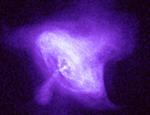 The Crab Nebula in X Rays
29.09.1999
Why does the Crab Nebula still glow? In the year 1054 A.D. a supernova was observed that left a nebula that even today glows brightly in every color possible, across the entire electromagnetic spectrum. At the nebula's center is an ultra-dense neutron star that rotates 30 times a second.
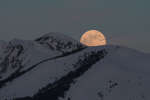 Largest Moon of 2009 Over the Alps
13.01.2009
A larger moon will not be seen this year. This past weekend, the largest full Moon of 2009 could be seen from almost any clear location on planet Earth at night. The high angular extent of the full Moon was caused by the Moon being unusually close to Earth during its full phase.
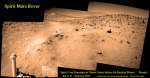 The Last Panorama of the Spirit Rover on Mars
30.05.2011
This is the last thing that the Spirit rover on Mars ever saw. Operating years beyond original expectations, Spirit eventually got mired in martian dirt and then ran out of power when investigating the unusual Home Plate surface feature on Mars.
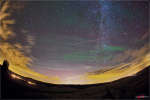 Airglow Over Germany
5.09.2012
Does air glow? It does, but it is usually hard to see. When conditions are right, however, a faint glow about 90 kilometers up can be observed, most easily with a wide-angle long-duration camera exposure.
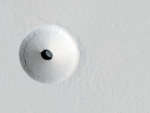 A Hole in Mars
9.03.2014
What created this unusual hole in Mars? The hole was discovered by chance in 2011 on images of the dusty slopes of Mars' Pavonis Mons volcano taken by the HiRISE instrument aboard the robotic Mars Reconnaissance Orbiter currently circling Mars.
 APOD: 2025 May 27 Б Zeta and Rho Ophiuchi with Milky Way
27.05.2025
Behold one of the most photogenic regions of the night sky, captured impressively. Featured, the band of our Milky Way Galaxy runs diagonally along the bottom-left corner, while the colorful Rho Ophiuchi cloud complex is visible just right of center and the large red circular Zeta Ophiuchi Nebula appears near the top.
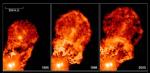 XZ Tauri System Ejects Gas Bubble
21.09.2000
Why is the binary star system XZ Tauri emitting a hot bubble of expanding gas? Although astronomers can only presently speculate, the Hubble Space Telescope clearly documents this unusual behavior in three dramatic photographs over the past five years.
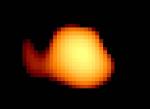 Resolving Mira
13.08.1997
Most stars appear only as points of light. Recently, Betelgeuse became the second star, after our Sun, to have it surface resolved. Now add Mira to the list. Mira A is a red giant star undergoing dramatic pulsations, causing it to become more than 100 times brighter over the course of a year.
|
January February March April May June July August |
||||||||||||||||||||||||||||||||||||||||||||||||||||||||