
|
You entered: unusual
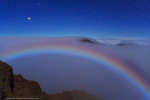 Mars and a Colorful Lunar Fog Bow
1.02.2010
Even from the top of a volcanic crater, this vista was unusual. For one reason, Mars was dazzlingly bright two weeks ago, when this picture was taken, as it was nearing its brightest time of the entire year. Mars, on the far upper left, is the brightest object in the above picture.
 The Snows of Paranal
11.08.2011
Recorded last week, this dawn portrait of snowy mountain and starry sky captures a very rare scenario. The view does feature a pristine sky above the 2,600 meter high mountain Cerro Paranal, but clear skies over Paranal are not at all unusual.
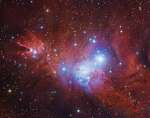 In the Vicinity of the Cone Nebula
6.08.2013
Strange shapes and textures can be found in neighborhood of the Cone Nebula. The unusual shapes originate from fine interstellar dust reacting in complex ways with the energetic light and hot gas being expelled by the young stars.
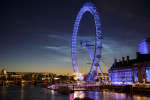 Noctilucent Clouds over London
10.07.2014
This scene from the early morning hours of July 3 looks out across the River Thames from the Westminster Bridge. Part of a luminous timelapse video (vimeo), the frame captures a sight familiar in London, the nighttime glow of the London Eye.
 Aurora over Clouds
29.05.2021
Auroras usually occur high above the clouds. The auroral glow is created when fast-moving particles ejected from the Sun impact the Earth's magnetosphere, from which charged particles spiral along the Earth's magnetic field to strike atoms and molecules high in the Earth's atmosphere.
 APOD: 2024 January 8 Б The Phases of Venus
7.01.2024
Venus goes through phases. Just like our Moon, Venus can appear as a full circular disk, a thin crescent, or anything in between. Venus, frequently the brightest object in the post-sunset or pre-sunrise sky, appears so small, however, that it usually requires binoculars or a small telescope to clearly see its current phase.
 APOD: 2024 February 7 Б The Heart Shaped Antennae Galaxies
6.02.2024
Are these two galaxies really attracted to each other? Yes, gravitationally, and the result appears as an enormous iconic heart -- at least for now. Pictured is the pair of galaxies cataloged as NGC 4038 and NGC 4039,known as the Antennae Galaxies.
 APOD: 2025 January 7 Б A New Years Aurora and SAR Arc
6.01.2025
It was a new year, and the sky was doubly red. The new year meant that the Earth had returned to its usual place in its orbit on January 1, a place a few days before its closest approach to the Sun.
 A Giant Gouge on Asteroid Eros
20.02.2000
Asteroid 433 Eros is posing several riddles. NASA's robot spacecraft NEAR began orbiting the 30-kilometer space rock last week, and new pictures are now being beamed back to Earth regularly. As usual in science, when you arrive at a place you've never been before, you see things you don't immediately understand.
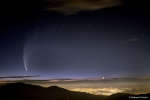 Comet McNaught Over Chile
27.01.2013
Comet McNaught of 2007 has been, so far, the most photogenic comet of our time. After making quite a show in the northern hemisphere in early 2007 January, the comet moved south and developed a long and unusual dust tail that dazzled southern hemisphere observers. In this image, Comet McNaught was captured above Santiago, Chile.
|
January February March April May June July August |
||||||||||||||||||||||||||||||||||||||||||||||||||||||||