
|
You entered: cluster
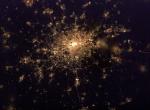 London at Night
11.04.2003
Do you recognize this intriguing globular cluster of stars? It's actually the constellation of city lights surrounding London, England, planet Earth, as recorded with a digital camera from the International Space Station. Taken in February 2003, north is toward the top and slightly left in this nighttime view.
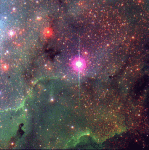 Starbirth in the Lagoon Nebula
24.10.1996
Stars are forming even today in the Lagoon Nebula. This bright nebula is visible in the constellation of Sagittarius with binoculars. The above photo is the result of a new sensitive camera being attached to one of the world's largest telescopes.
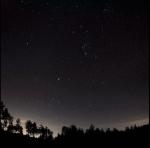 Cold Mountain Sky
4.03.2004
This lovely celestial view is surely a familiar one to winter skygazers in the northern hemisphere. Lights silhouetting the trees are from nearby towns Morganton and Rutherford College, North Carolina, USA. But the scene may also look familiar to attentive fans of the movie Cold Mountain, whose fictional characters discuss this same factual starry sky.
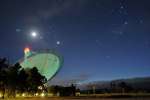 Dawn of the Dish
19.07.2012
Wandering planets Venus and Jupiter were joined by an old crescent Moon near the eastern horizon on July 15. This serene southern skyview of the much anticipated predawn conjunction includes the lovely Pleiades star cluster and bright stars Aldebaran and Betelgeuse in the celestial lineup.
 Sweeping Through Southern Skies
16.02.2013
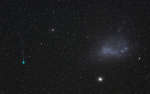
For now, Comet Lemmon (C/2012 F6a), and Comet PanSTARRS (C/2011 L4) are sweeping through southern skies. Lemmon's lime green coma and thin tail are near the left edge of this telephoto scene, a single frame from a timelapse video (vimeo here) recorded on February 12, tracking its motion against the background stars.
 NGC 4676: The Mighty Mice
14.06.2019
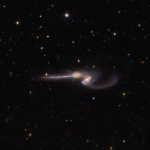
These two mighty galaxies are pulling each other apart. Known as The Mice because they have such long tails, each large spiral galaxy has actually passed through the other. Their long tails are drawn out by strong gravitational tides rather than collisions of their individual stars.
 NGC 6822: Barnard s Galaxy
2.12.2021
Grand spiral galaxies often seem to get all the glory, flaunting their young, bright, blue star clusters in beautiful, symmetric spiral arms. But small galaxies form stars too, like nearby NGC 6822, also known as Barnard's Galaxy.
 Antares and Rho Ophiuchi
22.09.1997
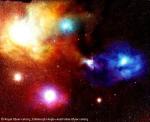
Why is the sky near Antares and Rho Ophiuchi so colorful? The colors result from a mixture of objects and processes. Fine dust illuminated from the front by starlight produces blue reflection nebulae. Gaseous clouds whose atoms are excited by ultraviolet starlight produce reddish emission nebulae. Backlit dust clouds block starlight and so appear dark.
 Pangea Ultima: Earth in 250 Million Years
22.09.2007
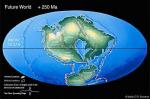
Is this what will become of the Earth's surface? The surface of the Earth is broken up into several large plates that are slowly shifting. About 250 million years ago, the plates...
 Amazing Comet Holmes
24.10.2008
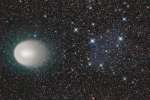
One year ago, Comet 17P/Holmes amazed sky watchers across planet Earth. A stunningly rapid outburst transformed it from a faint comet quietly orbiting the Sun with a period of about 7 years to a naked-eye comet rivaling the brighter stars in the constellation Perseus.
|
January February March April May June July August September October |
|||||||||||||||||||||||||||||||||||||||||||||||||